
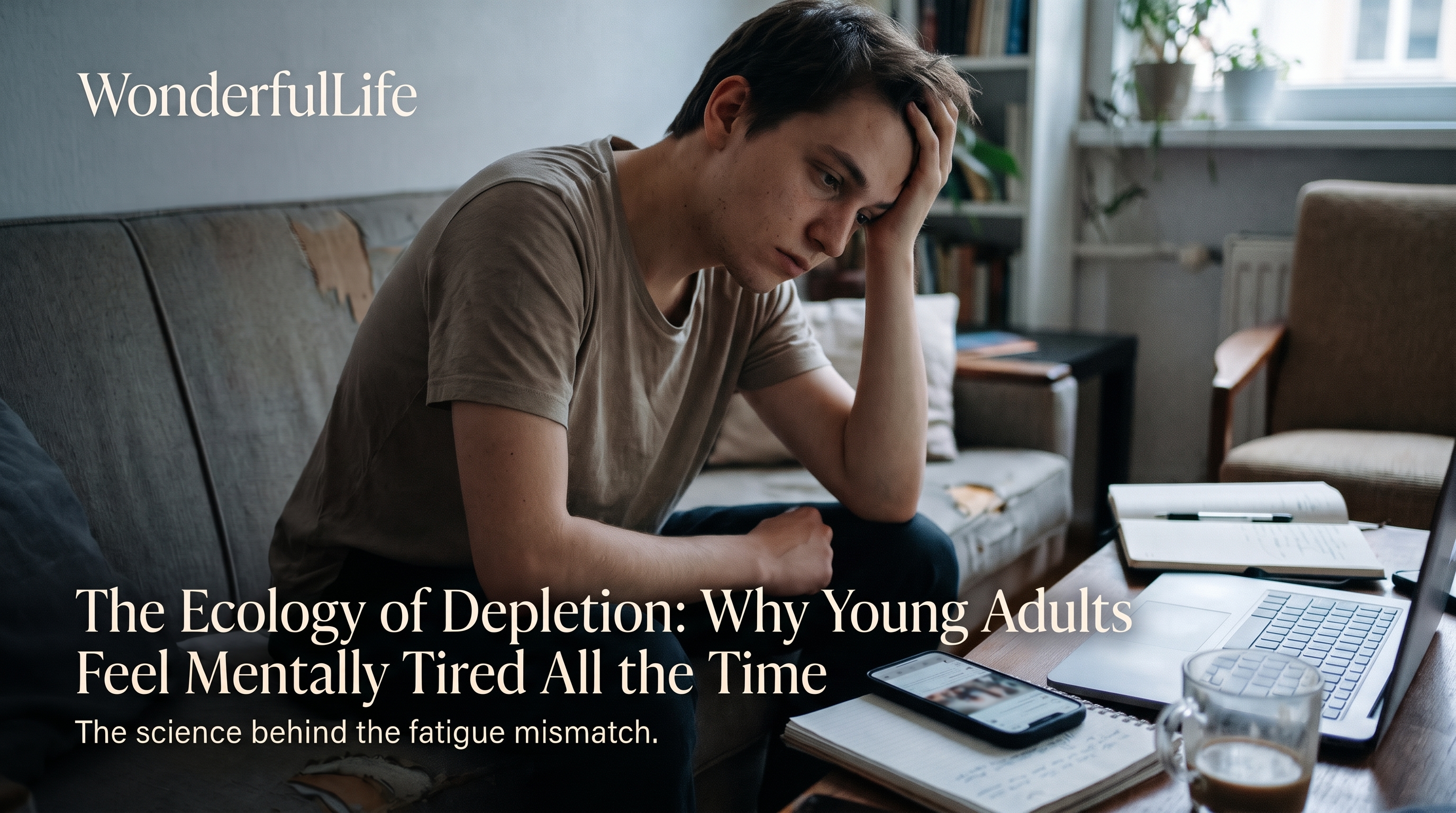
The Ecology of Depletion: Why Young Adults Are Trapped in Mental Fatigue
Introduction
Ask young adults how they feel, and a familiar response often emerges: “I’m just exhausted all the time.” Unlike physical exhaustion after strenuous activity, mental fatigue can manifest as persistent brain fog, difficulty concentrating, indecisiveness, and reduced emotional resilience. Although these experiences are frequently attributed to poor discipline or excessive screen time, their underlying causes may be more complex.
Modern life places increasing demands on attention, decision-making, social performance, and emotional regulation, while economic uncertainty and digital stimulation can limit opportunities for recovery. Drawing on cognitive psychology, neuroscience, and sociology, this article examines five interconnected contributors to mental fatigue and explores practical strategies for restoring cognitive well-being.
1.Attentional Fragmentation and Attention Residue
Human attention and working memory have limited capacities. However, digital environments encourage frequent switching between tasks, notifications, and competing sources of information.
Organizational psychologist Sophie Leroy (2009) introduced the concept of attention residue, describing how thoughts about a previous task can continue occupying cognitive resources after an individual switches to another activity. For example, a student interrupted by social media notifications may struggle to regain concentration even after returning to studying.
Gloria Mark (2023) further examines how frequent interruptions affect attention, stress, and productivity in digital environments. Repeated task switching can increase cognitive demands and make sustained concentration more difficult.
Although digital technology does not inherently cause mental fatigue, constant interruptions may reduce opportunities for uninterrupted thinking. Over time, individuals may experience greater mental effort when completing tasks that require sustained attention.
The problem is not simply excessive screen time, but the cumulative cognitive cost of repeatedly redirecting attention.
2.Decision Overload in an Economy of Constant Optimization
Young adults face continuous pressure to optimize their careers, finances, health, relationships, and personal development. Digital platforms intensify this pressure by presenting seemingly unlimited options and competing definitions of success.
In The Paradox of Choice, psychologist Barry Schwartz (2004) explains how excessive options can increase decision difficulty, dissatisfaction, and regret. When individuals believe every decision determines their future success, even ordinary choices can become psychologically demanding.
Choosing a career may involve comparing multiple qualifications, industries, and opportunities. Selecting a fitness routine can become an endless search for the most effective program. Even leisure activities may be evaluated according to their productivity or contribution to personal growth.
Although the idea that decision-making simply depletes a fixed reserve of willpower remains scientifically contested, excessive choices and persistent self-evaluation can contribute to subjective mental strain.
The deeper problem emerges when optimization becomes a constant expectation rather than an occasional strategy. Instead of experiencing life directly, individuals may become preoccupied with evaluating whether they are making the best possible choices.
When every decision becomes an optimization problem, ordinary life can begin to feel like a continuous performance evaluation.
3.The Disappearance of Psychological Privacy
In The Presentation of Self in Everyday Life, sociologist Erving Goffman (1959) distinguishes between front-stage behavior, in which individuals manage impressions before an audience, and back-stage environments, where they can relax these expectations.
Digital platforms complicate this distinction. Social media encourages individuals to document experiences, curate identities, and measure social feedback through likes, comments, and views. Professional platforms extend similar expectations into career development, where achievements and personal branding become increasingly visible.
Consequently, individuals may begin evaluating everyday experiences through an imagined audience. Holidays become content, exercise becomes evidence of discipline, and professional achievements become indicators of personal worth.
Jonathan Haidt (2024), in The Anxious Generation, examines concerns surrounding digital environments, social comparison, and young people’s mental health. However, the strength of causal relationships between social media use and psychological distress varies across individuals and contexts.
The concern is not that sharing experiences is inherently harmful. Rather, continuous self-monitoring may make it difficult to disengage from external judgment.
When individuals feel compelled to evaluate themselves even during private moments, opportunities for genuine psychological recovery may diminish.
4.Sleep Disruption and the Biology of Mental Recovery
Sleep supports memory consolidation, attention, emotional regulation, and other essential cognitive functions. Insufficient or disrupted sleep can contribute to daytime fatigue, impaired concentration, and increased emotional sensitivity.
Neuroscientific research has also investigated the glymphatic system, a mechanism associated with clearing metabolic waste from brain tissue. Xie and colleagues (2013), in a study published in Science, found that sleep promoted metabolite clearance in mice. Their findings contributed to understanding the relationship between sleep and brain maintenance, although the precise implications for human mental fatigue remain under investigation.
Digital habits may further complicate sleep. Late-night device use can delay bedtime, expose individuals to light that influences circadian rhythms, and prolong cognitive or emotional arousal. Notifications and stimulating content may also make it harder to disengage.
These effects vary according to individual circumstances, and screen exposure is not the only determinant of sleep quality. Nevertheless, when digital engagement consistently displaces restorative sleep, cognitive performance may suffer.
This can create a reinforcing cycle: fatigue reduces concentration, reduced concentration increases the time needed to complete tasks, and prolonged work leaves less time for recovery.
Sleep is not a reward for productivity; it is a biological foundation of cognitive and emotional well-being.
5.Chronic Uncertainty and Environmental Stress
Young adults increasingly navigate concerns about living costs, housing affordability, employment security, climate change, and technological disruption. Unlike immediate problems that can be resolved through direct action, these broader challenges may remain uncertain for years.
Persistent uncertainty can sustain worry and mental preoccupation, making psychological disengagement difficult even when individuals are not actively working.
The hypothalamic-pituitary-adrenal (HPA) axis plays an important role in the body’s response to stress. Prolonged or repeated stress exposure can influence physiological regulation, sleep, mood, and cognitive functioning. Research also associates chronic stress with inflammatory processes in certain contexts, although these relationships are complex and vary between individuals.
Economic insecurity may therefore affect more than financial circumstances. It can influence people’s ability to make long-term plans, pursue meaningful interests, or rest without feeling that they are falling behind.
This perspective does not eliminate personal responsibility. Instead, it recognizes that individual coping strategies cannot resolve every structural problem.
Mental fatigue may reflect not only the demands of daily responsibilities, but also the psychological burden of uncertainties that individuals cannot fully control.
The Path Forward: Deliberate Cognitive Recovery
Addressing mental fatigue requires more than greater discipline. It requires creating conditions that support attention, recovery, and sustainable functioning.
First, protecting uninterrupted attention through notification management and focused work periods can reduce unnecessary cognitive switching.
Second, reclaiming low-stimulation time allows individuals to step away from continuous digital input. Walking without scrolling or spending a few minutes in quiet can create opportunities for mental disengagement.
Third, establishing consistent sleep schedules and reducing stimulating activities before bedtime can support recovery. A 30- to 60-minute wind-down routine may provide a practical starting point.
Fourth, practicing satisficing—choosing an option that meets reasonable criteria rather than searching indefinitely for the perfect choice—can reduce unnecessary decision-making. This approach is particularly useful for low-stakes decisions.
Finally, individuals should recognize when fatigue reflects excessive workloads, financial insecurity, or possible health concerns. Persistent exhaustion that interferes with everyday functioning warrants appropriate professional assessment rather than an assumption that better productivity habits alone will solve the problem.
Conclusion
Mental fatigue among young adults cannot be explained by a single cause. Attentional fragmentation, decision overload, social comparison, sleep disruption, and chronic uncertainty may interact to undermine cognitive and emotional well-being.
Although individual habits matter, understanding mental fatigue requires examining the environments in which people live, work, study, and develop their identities.
A culture that rewards constant availability, relentless optimization, and continuous self-evaluation may leave insufficient room for genuine recovery.
The solution is not to reject ambition or technology, but to recognize human cognitive limits and create more sustainable conditions for functioning.
The path out of mental depletion begins not with demanding more from the mind, but with creating the conditions in which the mind can function well.
References and Academic Credits
- Leroy, S. (2009). Why is it so hard to do my work? The challenge of attention residue when switching between work tasks. Organizational Behavior and Human Decision Processes, 109(2), 168–181.
- Mark, G. (2023). Attention Span: A Groundbreaking Way to Restore Balance, Happiness and Productivity. Harper Horizon.
- Schwartz, B. (2004). The Paradox of Choice: Why More Is Less. Ecco / HarperCollins Publishers.
- Goffman, E. (1959). The Presentation of Self in Everyday Life. Anchor Books / Doubleday.
- Xie, L., Kang, H., Xu, Q., Chen, M. J., Liao, Y., Thiyagarajan, M., O’Donnell, J., Christensen, D. J., Nicholson, C., Iliff, J. J., Takano, T., Deane, R., & Nedergaard, M. (2013). Sleep drives metabolite clearance from the adult brain. Science, 342(6156), 373–377. https://doi.org/10.1126/science.1241224
- Haidt, J. (2024). The Anxious Generation: How the Great Rewiring of Childhood Is Causing an Epidemic of Mental Illness. Penguin Press.
- American Psychological Association (APA). Stress in America: A Nation in Political and Economic Turmoil. APA annual survey reports.












WonderfulLife Community
Join the Conversation