
Stress and Your Body: How Everyday Pressure Affects Metabolism, Digestion, and Sleep
When we think about improving our health, nutrition and exercise usually receive most of the attention.
But there is another important part of the picture:
Stress.
Stress is not automatically harmful.
In fact, the human stress response is an essential survival system that helps us adapt to challenges, respond to danger, concentrate under pressure, and mobilize energy when we need it.
The problem is not that we experience stress.
The challenge arises when psychological or physical demands become persistent and the body has too little opportunity for recovery.
Over time, chronic stress can influence sleep, appetite, digestion, cardiovascular function, metabolism, mood, and everyday well-being.
Understanding that relationship gives us another powerful reason to make recovery part of a healthy lifestyle.
What Actually Happens During the Stress Response?
When the brain perceives a threat or significant challenge, several interconnected biological systems respond.
One is the sympathetic nervous system, which helps produce the familiar "fight-or-flight" response.
Hormones and neurotransmitters including adrenaline help prepare the body for immediate action.
Heart rate may increase.
Blood pressure can rise.
Attention becomes more focused.
Stored energy becomes more readily available.
Another important system is the hypothalamic-pituitary-adrenal axis, commonly called the HPA axis.
Through a sequence of hormonal signals, the HPA axis stimulates the adrenal glands to release cortisol.
Cortisol Isn't the Enemy
Cortisol is frequently portrayed in wellness content as a harmful "stress hormone."
That description is misleading.
Cortisol is essential for life.
It participates in:
- Energy metabolism
- Blood-pressure regulation
- Immune function
- Glucose availability
- The sleep-wake cycle
- The body's response to physical and psychological stress
Cortisol also follows a natural daily rhythm.
Levels generally rise around the time we wake and decline across the day, although individual patterns vary.
The goal is therefore not to eliminate cortisol.
The goal is healthy regulation of the stress-response system.
Acute Stress vs. Chronic Stress
A short-lived stress response can be useful.
Imagine narrowly avoiding an accident.
Your heart beats faster.
Your attention sharpens.
Energy becomes rapidly available.
Once the danger passes, these systems can gradually return toward baseline.
Modern stress, however, often looks very different.
Instead of escaping a physical threat, we may experience:
- Work deadlines
- Financial pressure
- Family responsibilities
- Traffic
- Constant notifications
- Information overload
- Poor sleep
- Social conflict
- Caregiving demands
- Lack of recovery time
These stressors do not necessarily cause the body to remain in one continuous "fight-or-flight" state.
Human stress physiology is more complicated than an on/off switch.
But repeated or prolonged stress can alter stress-response patterns and influence several aspects of physical and psychological health.
- Stress, Blood Glucose, and Appetite
During an acute stress response, the body may increase the availability of glucose and other energy substrates.
That makes sense from an evolutionary perspective.
If immediate action is required, muscles and other tissues need accessible fuel.
Cortisol participates in this energy-regulation system.
With chronic stress, however, the relationship becomes more complex.
Long-term psychological stress has been associated with changes in:
- Appetite
- Food preferences
- Insulin sensitivity
- Glucose regulation
- Body-fat distribution
- Eating behavior
But people do not all respond to stress in the same way.
Some people eat more when stressed.
Others lose their appetite.
Some gravitate toward highly palatable foods rich in sugar or fat.
Others experience very little change.
So rather than saying stress automatically causes blood-sugar spikes or sugar cravings, it is more accurate to say:
Stress can influence both metabolic regulation and eating behavior.
Why Comfort Foods Can Feel So Appealing
Stress eating is not simply a failure of willpower.
Food is rewarding.
Taste, texture, aroma, memory, habit, and emotional associations all influence eating behavior.
When people are tired or under pressure, highly palatable foods can become especially appealing.
This is one reason stress management can be relevant to nutrition.
Sometimes improving eating habits isn't only about changing what is in the refrigerator.
It is also about understanding what is happening in the rest of your life.
- Stress and Digestion
The digestive system and nervous system are deeply interconnected.
This communication network is sometimes described as part of the gut-brain axis.
Stress can influence gastrointestinal function through neural, hormonal, immune, and behavioral pathways.
Depending on the person, stress may affect:
- Gut motility
- Appetite
- Bowel habits
- Abdominal sensations
- Digestive comfort
Some people notice an urgent need to use the bathroom when anxious.
Others experience constipation.
Some lose their appetite.
Others experience nausea, abdominal discomfort, or changes in digestive symptoms.
This variability is important.
The popular explanation that the body simply "diverts all its energy away from digestion" during stress is too simplistic.
Digestion continues, but nervous-system activity and stress signaling can modify gastrointestinal function.
Stress Doesn't Explain Every Digestive Problem
It is equally important not to dismiss persistent digestive symptoms as "just stress."
Bloating, abdominal pain, diarrhea, constipation, reflux, unexplained weight loss, blood in the stool, or other persistent symptoms can have many causes.
Stress may influence gastrointestinal symptoms without being their underlying cause.
Ongoing or concerning digestive symptoms deserve appropriate medical evaluation.
- Stress and Sleep
Stress and sleep have a particularly close relationship.
Psychological stress can make it harder to:
- Wind down at night
- Fall asleep
- Remain asleep
- Return to sleep after waking
And the relationship works in both directions.
Poor sleep can affect emotional regulation and make everyday stressors feel more difficult to manage.
This can create a frustrating cycle:
Stress disrupts sleep → poor sleep reduces resilience → the next day feels more stressful.
Cortisol and melatonin both participate in circadian physiology, but insomnia should not simply be described as "high evening cortisol blocking melatonin."
Sleep regulation involves a complex interaction between circadian rhythms, sleep pressure, light exposure, behavior, environment, stress, health, medications, and many other factors.
Recovery Is Part of Health
We cannot eliminate every source of stress.
Nor should we expect to.
Deadlines will still happen.
Traffic will still exist.
Phones will still ring.
Families will still need us.
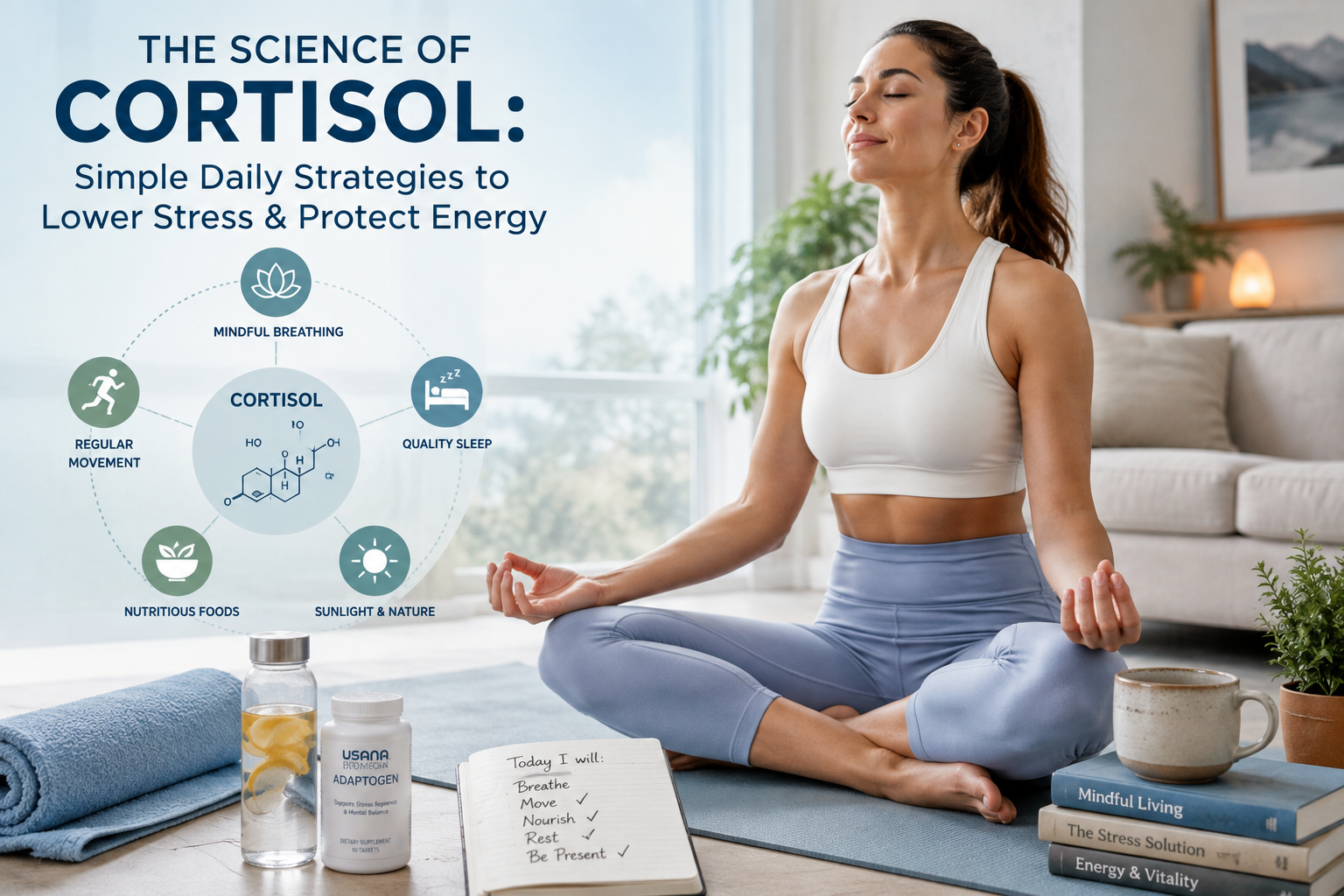
The more realistic goal is to build recovery opportunities into everyday life.
These do not have to be elaborate.
Small periods of recovery can help interrupt long stretches of mental and physical tension.
Three Simple Ways to Create More Recovery
You don't need an hour-long meditation routine.
Start with practices that can realistically fit into your day.
- Use Your Breath as a Reset
Breathing is unusual because it happens automatically but can also be consciously controlled.
Slow, deliberate breathing has been studied for its effects on physiological arousal and emotional state.
One technique receiving research attention is sometimes called cyclic sighing.
It involves taking an inhale, following it with another smaller inhale, and then completing a longer, slower exhale.
A simple version might look like this:
Inhale gently through your nose. Take a second smaller inhale. Exhale slowly and comfortably.
Repeat several times without forcing the breath.
Research suggests that structured breathing practices can influence physiological arousal and mood.
But there is no need to claim that several breaths instantly "reset" the nervous system.
Think of breathing exercises as one useful tool for creating a brief period of intentional calm.
- Get Outside in the Morning
Morning light is one of the strongest environmental signals received by the circadian system.
Specialized light-sensitive cells in the eyes communicate information about environmental light to the brain's central biological clock.
Regular exposure to daytime light—particularly earlier in the day—can help reinforce the timing of the sleep-wake cycle.
That does not mean everyone needs exactly 10 or 15 minutes.
The amount of useful light exposure depends on:
- Weather
- Season
- Latitude
- Cloud cover
- Time of day
- Individual circumstances
A simple habit is enough:
Get outside relatively early in your day when possible.
Walk around the block.
Drink your morning coffee outside.
Take the dog for a walk.
Combine morning light with movement and you gain two healthy habits at once.
Never look directly at the sun.
- Create Micro-Breaks
Modern life has become extraordinarily good at eliminating empty moments.
Waiting for an elevator?
Check the phone.
Standing in line?
Check the phone.
Two minutes before the next meeting?
Check email.
Even our breaks can become another source of information and stimulation.
A micro-break simply means allowing a brief period without another demand.
Try:
- Standing and stretching
- Walking for two minutes
- Looking out a window
- Getting a glass of water
- Stepping outside
- Taking several comfortable breaths
- Sitting quietly
- Leaving your phone alone for a moment
You don't need to optimize the break.
The break is the point.
Movement Is a Powerful Stress Tool
Physical activity deserves special attention.
Exercise can influence stress physiology, sleep, mood, cardiovascular function, and metabolic health.
It does not need to be intense.
Try:
- Walking
- Cycling
- Gardening
- Yoga
- Tai chi
- Swimming
- Strength training
- Dancing
For some people, a walk may be more restorative than another 20 minutes scrolling through social media.
The key is finding movement that fits your life.
Protect the Transition Into Sleep
If stress follows you into bed, create a small transition between the active part of your day and sleep.
That might include:
- Dimming bright lights
- Putting work away
- Reducing stimulating content
- Taking a warm shower
- Reading
- Gentle stretching
- Quiet music
- Preparing tomorrow's tasks earlier so you don't rehearse them in bed
You don't need a perfect nighttime routine.
Consistency is more important than complexity.
Don't Turn Stress Management Into Another Source of Stress
This is especially important.
Wellness culture sometimes creates a strange contradiction:
You become stressed because you aren't managing your stress perfectly.
You don't need perfect cortisol.
You don't need to meditate every morning.
You don't need an expensive wearable telling you whether you are "recovered."
And you don't need to feel calm every moment of the day.
Stress is part of life.
Resilience is not the absence of stress.
It is the capacity to respond, recover, adapt, and continue.
The WonderfulLife Bottom Line
Health isn't built only through food and exercise.
Recovery matters too.
Your nervous system, digestive system, metabolism, cardiovascular system, and sleep-wake cycle are constantly responding to the environment around you.
You cannot control every stressor.
But you can create small opportunities for recovery:
Take a few slow breaths. Get outside. Move your body. Step away from the screen. Protect your sleep. Create moments without input. Connect with people you care about.
None of these practices needs to be perfect.
And none will make life completely stress-free.
That's not the goal.
The goal is to give your body opportunities to recover between life's demands.
Sometimes the healthiest thing you can add to your day isn't another supplement, workout, or nutrition rule.
It's a little room to recover.
Scientific References & Sources
- Kuo, L. E., et al. (2007). Chronic stress, combined with a high-fat/high-sugar diet, shifts sympathetic signaling toward neuropeptide Y and promotes obesity and the metabolic syndrome. Nature Medicine, 13(7), 803–811.
- Yaribeygi, H., Panahi, Y., Sahraei, H., Johnston, T. P., & Sahebkar, A. (2017). The impact of stress on body function: A review. EXCLI Journal, 16, 1057–1072.
- Balban, M. Y., et al. (2023). Brief structured respiration practices enhance mood and reduce physiological arousal. Cell Reports Medicine, 4(1), 100895.
Medical & Wellness Disclaimer
The information provided on WonderfulLife.ca is for educational, informational, and general wellness purposes only and is not intended as medical advice, diagnosis, or treatment.
Persistent stress, anxiety, sleep disturbance, digestive symptoms, changes in appetite, or other physical or psychological symptoms can have many causes and may require professional evaluation.
Stress-management practices such as breathing exercises, movement, outdoor activity, and relaxation techniques should complement—not replace—appropriate medical or mental-health care when it is needed.
Always seek advice from a physician or other qualified healthcare professional regarding persistent or concerning symptoms.
Never disregard professional medical advice or delay seeking care because of information you have read on this website.
Credits
Author: WonderfulLife Editorial Team Editorial Assistance: Gemini Published For: WonderfulLife.ca










WonderfulLife Community
Join the Conversation