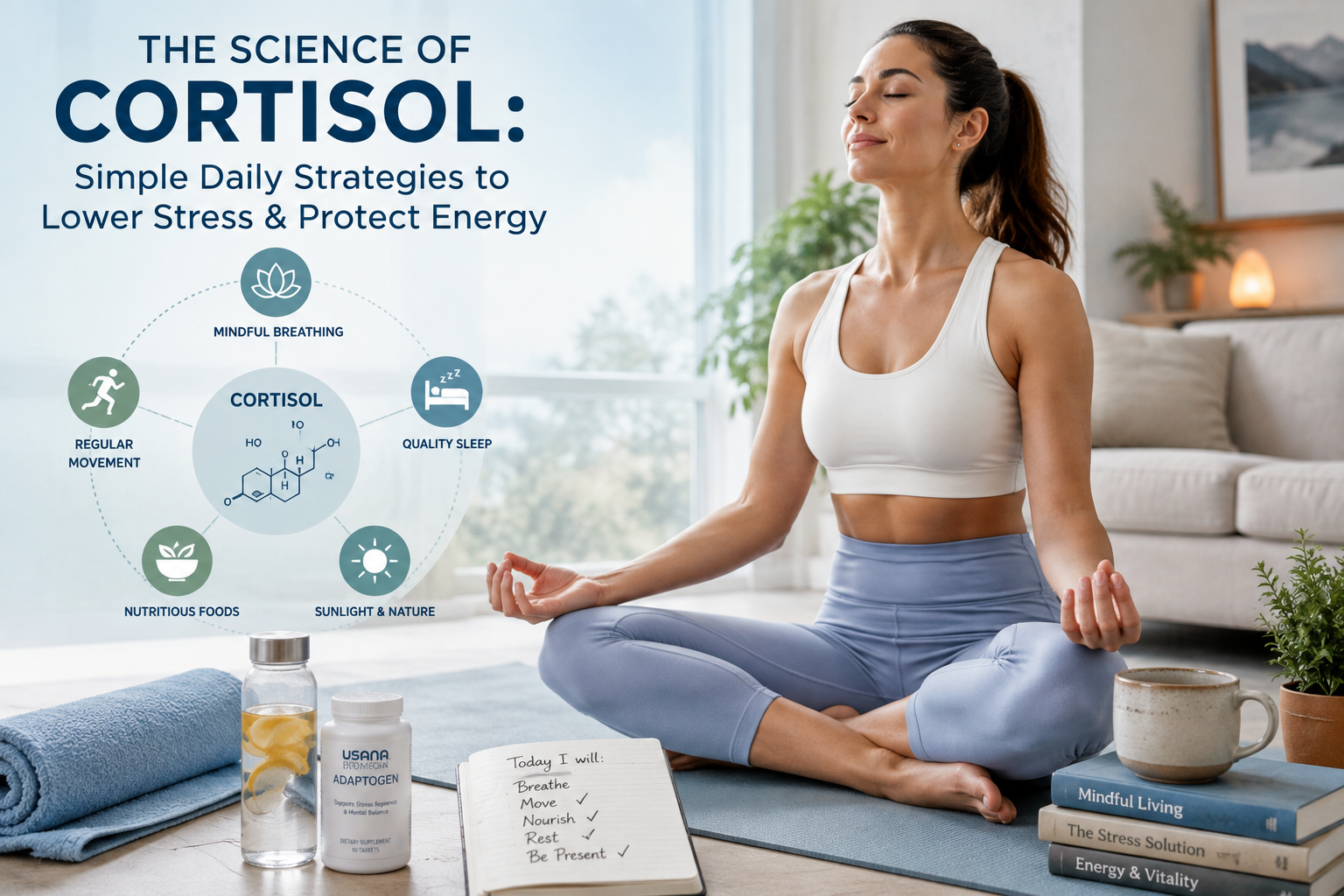
Cortisol and Stress: What This Hormone Really Does
When you encounter a demanding situation—whether a work deadline, intense exercise, illness, or an unexpected personal challenge—your body activates several coordinated stress-response systems.
One of the most important is the hypothalamic-pituitary-adrenal axis, commonly called the HPA axis.
Through a sequence of hormonal signals involving the brain, pituitary gland, and adrenal glands, the HPA axis helps regulate the release of cortisol.
Cortisol is often called the body’s “stress hormone,” but that description can make it sound harmful.
It is not.
Cortisol is an essential hormone involved in:
- Energy metabolism
- Glucose regulation
- Blood-pressure support
- Immune regulation
- Circadian rhythms
- Adaptation to physical and psychological stress
The goal is not to eliminate cortisol.
The goal is a healthy, appropriately regulated stress response.
Cortisol Follows a Daily Rhythm
Cortisol normally changes across the day.
In many people, levels rise around waking and then gradually decline toward evening.
A distinct rise shortly after awakening—known as the cortisol awakening response—has been observed in many individuals, although its size and timing vary.
This rhythm is influenced by:
- Sleep
- Light exposure
- Shift work
- Stress
- Illness
- Medications
- Circadian timing
- Individual biology
It is therefore too simplistic to say that healthy cortisol always peaks at one exact time or follows an identical pattern in everyone.
Acute Stress Can Be Useful
Short-term stress responses are part of normal physiology.
If immediate action is needed, the body may:
- Increase alertness
- Mobilize stored energy
- Raise heart rate
- Alter blood flow
- Change immune signaling
These responses can be adaptive.
A hard workout, public presentation, job interview, or competitive event can all activate stress physiology without necessarily harming health.
The more important issue is recovery.
When demands are repeated or prolonged and recovery is inadequate, stress can begin to affect sleep, mood, appetite, metabolism, and overall well-being.
Chronic Stress Does Not Always Mean “High Cortisol”
This distinction is important.
Chronic psychological stress can alter HPA-axis function, but the pattern is not always a simple, permanently elevated cortisol level.
Different people and different conditions may be associated with:
- Higher cortisol at certain times
- Flatter daily cortisol rhythms
- Altered awakening responses
- Changes in cortisol reactivity
- Other stress-system adaptations
That is why trying to diagnose yourself with “high cortisol” based on fatigue, cravings, belly fat, or poor sleep is unreliable.
Those symptoms can have many causes.
- Stress, Energy, and Fatigue
Stress can influence how energetic we feel.
During an acute stress response, energy substrates can become more available to help the body respond.
But persistent stress may also contribute to:
- Poor sleep
- Mental fatigue
- Reduced motivation
- Changes in activity
- Changes in appetite
- Difficulty recovering
That does not mean cortisol directly causes every afternoon crash.
Fatigue is influenced by many factors, including sleep quality, nutrition, medical conditions, medications, mood, and physical activity.
Persistent or unexplained fatigue deserves proper evaluation.
- Stress and Blood Glucose
Cortisol participates in glucose regulation.
During stress, the liver may increase glucose production so that energy is available when needed.
This is a normal physiological response.
Over time, chronic stress may interact with:
- Insulin sensitivity
- Eating behavior
- Physical activity
- Sleep
- Body composition
But the relationship is complex.
It is not accurate to say that every stressful event creates “excess glucose” that automatically becomes abdominal fat.
Metabolic health is influenced by many interacting factors.
- Stress and Appetite
Some people eat more under stress.
Others eat less.
Some become especially drawn to highly palatable foods.
Stress-related eating can be influenced by:
- Reward pathways
- Habit
- Sleep deprivation
- Emotional state
- Food availability
- Social context
So rather than framing cravings as a direct result of cortisol, a more useful perspective is:
Stress can change the context in which food decisions are made.
- Stress and Digestion
The digestive system and nervous system communicate continuously.
Stress can influence:
- Gut motility
- Appetite
- Abdominal sensations
- Bowel habits
- Digestive comfort
But the body does not simply “turn off” digestion whenever stress occurs.
And stress should not be blamed automatically for bloating, reflux, constipation, diarrhea, or other digestive symptoms.
Persistent symptoms may have medical causes and deserve appropriate evaluation.
- Stress, Memory, and Concentration
Stress can affect cognitive performance.
Acute stress may sometimes sharpen attention toward immediate demands.
But prolonged or intense stress can make it harder to:
- Concentrate
- Make decisions
- Remember information
- Regulate emotions
The hippocampus and other brain regions involved in memory and stress regulation are active areas of research.
Still, it is too simplistic to say that cortisol alone causes “brain fog.”
Cognition is influenced by many factors, including sleep, mood, medications, nutrition, and overall health.
- Stress and Sleep
Stress and sleep strongly influence one another.
Stress can make it harder to wind down, fall asleep, or remain asleep.
Poor sleep can then reduce resilience the following day.
This can create a cycle:
Stress disrupts sleep → poor sleep reduces resilience → everyday demands feel harder
Cortisol participates in circadian physiology, but insomnia should not be reduced to a single hormone problem.
Sleep timing, light, behavior, environment, sleep disorders, medications, and mental health all matter.
Four Practical Ways to Support Stress Regulation
You do not need to “hack” your cortisol.
The goal is to support the systems that help your body respond to stress and recover afterward.
- Get Daylight Early in Your Day
Light is one of the strongest environmental signals for the circadian system.
Morning or early daytime light helps reinforce the timing of wakefulness and sleep.
A practical habit might be:
- Take a short walk after waking
- Drink coffee outside
- Eat breakfast near natural light
- Step outdoors before beginning work
You do not need to stare at the sun or follow an exact 30-minute rule.
Simply getting outdoor light relatively early in the day can help provide a strong daytime signal to your biological clock.
- Use Slow Breathing as a Short Reset
Breathing practices can influence physiological arousal.
One technique studied recently is cyclic sighing.
A simple version looks like:
Inhale gently through the nose. Take a second smaller inhale. Exhale slowly and comfortably.
Repeat several times.
Structured breathing practices may help reduce physiological arousal and improve mood in some people.
But avoid thinking of them as an instant “vagus nerve reset.”
They are better understood as one practical tool for creating a brief period of calm.
- Build Regular Meals That Support Energy
Extreme hunger, erratic meal patterns, and highly restrictive dieting can make some people feel worse during stressful periods.
A balanced meal can include:
- High-quality protein
- Fiber-rich carbohydrates
- Vegetables or fruit
- Healthy fats
Examples include:
Oatmeal + Greek yogurt + berries + nuts
Lentils + vegetables + olive oil + whole grains
Salmon + potatoes + vegetables
The goal is not to prevent every glucose fluctuation or “protect the adrenals.”
It is simply to provide consistent nourishment.
- Protect Recovery Time
Recovery does not have to mean meditation.
It can include:
- Walking
- Stretching
- Reading
- Listening to music
- Gardening
- Spending time outdoors
- Talking with someone you trust
- Taking a break from screens
- Sleeping enough
The best recovery strategy is one you will actually use.
What About Magnesium?
Magnesium is an essential mineral involved in hundreds of biochemical reactions.
It contributes to:
- Normal nerve function
- Muscle function
- Energy metabolism
- Electrolyte balance
Some research has explored magnesium supplementation for stress or anxiety, particularly in people with low intake.
But evidence is mixed.
Magnesium should not be marketed as a guaranteed cortisol-lowering supplement.
Food sources include:
- Pumpkin seeds
- Almonds
- Beans
- Whole grains
- Leafy greens
- Dark chocolate
Supplementation may be appropriate for some people, depending on diet and medical circumstances.
What About B-Complex Vitamins?
B vitamins participate in energy metabolism and many other cellular processes.
Deficiencies can affect health.
But taking extra B vitamins does not necessarily improve stress resilience in someone who is already nutritionally adequate.
The better approach is to:
- Eat a varied diet
- Correct deficiencies when they exist
- Use supplements when they serve a real nutritional need
What About Adaptogens?
The term adaptogen is used for certain herbs promoted for stress resilience.
Two of the most commonly discussed are:
- Ashwagandha (Withania somnifera)
- Rhodiola (Rhodiola rosea)
Some clinical trials have reported improvements in self-reported stress or anxiety measures with certain standardized extracts.
However, these products should not be treated as universally safe.
Ashwagandha Safety Matters
Ashwagandha may not be appropriate for everyone.
Potential concerns can include:
- Thyroid effects
- Liver injury in rare reported cases
- Sedation
- Gastrointestinal effects
- Medication interactions
It should generally be avoided during pregnancy unless specifically recommended by an appropriate healthcare professional.
People with thyroid disease, autoimmune conditions, liver problems, or those taking medications should discuss use with a qualified professional.
Rhodiola Also Requires Caution
Rhodiola is also being studied for stress and fatigue, but evidence varies by extract, dose, and population.
Potential side effects and medication interactions are possible.
Herbal products should be evaluated like any other biologically active substance.
“Natural” does not automatically mean risk-free.
Don’t Diagnose “Adrenal Fatigue” From Symptoms
Fatigue, poor concentration, difficulty sleeping, and low energy are real symptoms.
But “adrenal fatigue” is not a recognized medical diagnosis.
True adrenal disorders do exist, including adrenal insufficiency, and they require medical testing and treatment.
If you experience persistent:
- Severe fatigue
- Unexplained weight changes
- Dizziness
- Low blood pressure
- Muscle weakness
- Significant changes in appetite
- Other concerning symptoms
seek appropriate medical evaluation rather than relying on “adrenal support” supplements.
The WonderfulLife Bottom Line
Cortisol is not the enemy.
It is an essential hormone that helps your body respond to life.
The goal is not to eliminate stress or drive cortisol as low as possible.
The goal is to create a healthy rhythm of:
Demand → Response → Recovery
Support that rhythm with:
Daylight. Movement. Regular nourishment. Adequate sleep. Breathing or relaxation practices. Social connection. Time away from constant stimulation.
Supplements may have a role when they address a real nutritional need or are used appropriately under professional guidance.
But stress resilience is built primarily through the way we live.
You do not need perfect cortisol. You need enough recovery to meet the demands of your life.
Scientific References & Sources
- Herman, J. P., et al. (2016). Regulation of the hypothalamic-pituitary-adrenocortical stress response. Comprehensive Physiology, 6(2), 603–621.
- Adam, E. K., et al. (2017). Diurnal cortisol slopes and mental and physical health outcomes: A systematic review. Psychoneuroendocrinology, 83, 25–41.
- Chandrasekhar, K., Kapoor, J., & Anishetty, S. (2012). A prospective, randomized double-blind, placebo-controlled study of safety and efficacy of a high-concentration full-spectrum extract of ashwagandha root in reducing stress and anxiety in adults. Indian Journal of Psychological Medicine, 34(3), 255–262.
- Boyle, N. B., Lawton, C., & Dye, L. (2017). The effects of magnesium supplementation on subjective anxiety and stress—A systematic review. Nutrients, 9(5), 429.
Medical & Wellness Disclaimer
The information provided on WonderfulLife.ca is for educational, informational, and general wellness purposes only and is not intended as medical advice, diagnosis, or treatment.
Persistent fatigue, sleep disturbance, anxiety, digestive symptoms, mood changes, or suspected hormonal problems can have many causes and may require professional evaluation.
Do not use dietary supplements or herbal products as substitutes for appropriate medical or mental-health care.
Ashwagandha, rhodiola, magnesium, and other supplements may interact with medications or may not be appropriate for certain health conditions.
Always consult with a physician, pharmacist, Registered Dietitian, or other qualified healthcare professional before beginning a new supplement, particularly if you are pregnant or breastfeeding, take prescription medication, or have thyroid, liver, autoimmune, cardiovascular, psychiatric, or other medical conditions.
Never disregard professional medical advice or delay seeking care because of information you have read on this website.
Credits
Author: WonderfulLife Editorial Team Editorial Assistance: Gemini Published For: WonderfulLife.ca











WonderfulLife Community
Join the Conversation