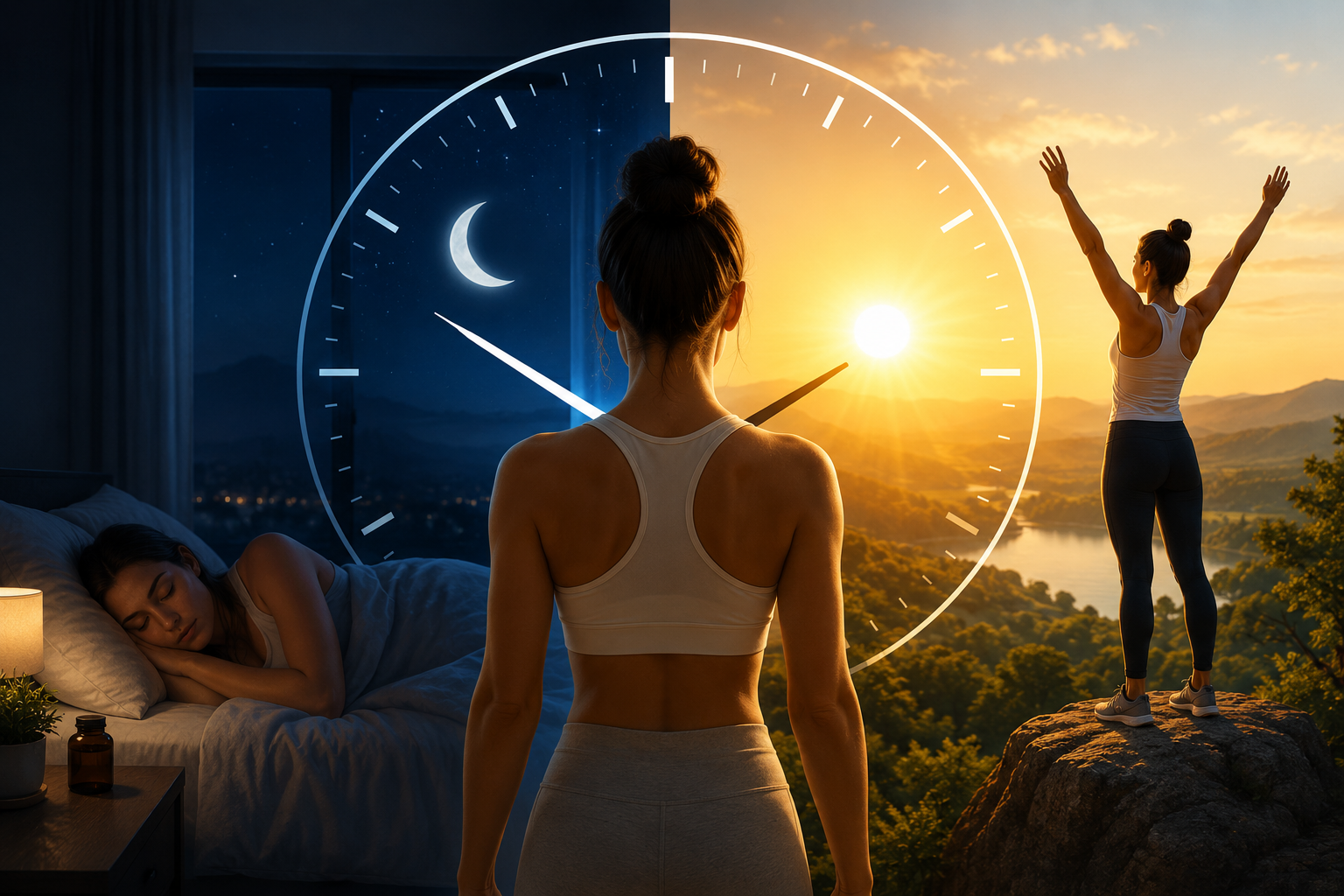
The Circadian Rhythm Code: Resetting Your Internal Clock for Better Sleep and Daytime Energy
Deep within the hypothalamus of the brain is a tiny region called the suprachiasmatic nucleus, or SCN.
Containing roughly 20,000 neurons, the SCN acts as a central coordinator of the body's circadian timing system.
Circadian rhythms are biological patterns that repeat over approximately 24 hours.
They influence far more than sleep.
Your circadian system helps coordinate daily changes in:
- Sleep and wakefulness
- Alertness
- Hormone secretion
- Core body temperature
- Digestion
- Glucose metabolism
- Immune activity
- Physical performance
The SCN does not work alone.
Nearly every major organ and tissue contains its own molecular clocks, creating a network of central and peripheral clocks throughout the body.
The goal is not to make these clocks perfectly rigid.
It is to give them reasonably consistent environmental signals.
What Is Circadian Misalignment?
Circadian misalignment occurs when biological timing becomes poorly aligned with behavior or the external environment.
Common examples include:
- Shift work
- Jet lag
- Highly irregular sleep schedules
- Bright nighttime light exposure
- Sleeping late on some days and waking very early on others
- Eating and activity patterns occurring at very different times each day
Modern life can make this easier to experience.
We spend much of the day indoors.
Artificial light extends well into the evening.
Work can continue late into the night.
Meals may happen at widely different times.
And smartphones allow stimulation to continue long after natural daylight has disappeared.
Circadian disruption does not automatically explain every case of fatigue, poor digestion, or sleep difficulty.
But maintaining a reasonably regular daily rhythm can support healthy sleep and metabolic function.
Three Important Signals That Help Set Biological Time
Environmental signals that influence circadian timing are sometimes called zeitgebers, a German word meaning “time-givers.”
Several are especially important.
- Light: The Strongest Circadian Signal
Light is the primary environmental signal for the central circadian clock.
Specialized cells in the retina called intrinsically photosensitive retinal ganglion cells, or ipRGCs, detect environmental light and communicate with the SCN.
These cells are particularly sensitive to shorter-wavelength light, but circadian responses depend on more than one narrow band of “blue light.”
Brightness, timing, duration, and previous light exposure all matter.
Why Morning and Daytime Light Matter
Exposure to bright light during the earlier part of the day helps reinforce the biological signal that daytime has begun.
This can support:
- Daytime alertness
- Circadian timing
- A more consistent sleep-wake pattern
Outdoor light is generally much brighter than typical indoor lighting—even on many cloudy days.
A practical habit is therefore simply:
Get outside relatively early in your day when possible.
You do not need to stare at the sun.
And you do not need to avoid medically necessary sunglasses.
Ordinary outdoor exposure provides a much stronger light signal than most indoor environments.
Evening Darkness Matters Too
As evening progresses and environmental light decreases, the circadian system receives information that biological night is approaching.
Melatonin secretion generally rises during the evening under dim-light conditions.
Melatonin is often called a “sleep hormone,” but it is more accurately understood as a signal of biological night.
It helps coordinate the body's transition toward nighttime physiology.
Screens Are Only Part of the Evening-Light Story
Smartphones and tablets are often blamed entirely on “blue light.”
That is only part of the picture.
Screens can influence sleep because they may:
- Deliver light close to the eyes
- Keep the brain mentally engaged
- Encourage bedtime procrastination
- Extend work or social interaction
- Expose us to stimulating or emotional content
So rather than fearing all blue wavelengths, focus on creating a dimmer, calmer evening environment.
- Meal Timing and Peripheral Clocks
The SCN acts as an important central clock, but peripheral tissues also contain circadian timing systems.
These include tissues in the:
- Liver
- Pancreas
- Gastrointestinal tract
- Skeletal muscle
- Adipose tissue
Food intake can act as a timing signal for some of these peripheral clocks.
Researchers are therefore interested in how meal timing interacts with metabolic health.
Does Everyone Need an 8-to-10-Hour Eating Window?
No.
Time-restricted eating is an active area of research, and some studies suggest metabolic benefits in particular populations.
But an 8-to-10-hour eating window is not a universal requirement for circadian health.
Meal timing needs to fit:
- Medical conditions
- Medication schedules
- Pregnancy
- Physical activity
- Work schedule
- Age
- Total nutritional needs
A simpler principle is more appropriate for most people:
Try to keep meals reasonably consistent and avoid making very large late-night meals a routine if they interfere with sleep or digestion.
Late Meals Are Not Automatically Harmful
Eating at night does not instantly “shut down overnight repair.”
That phrase oversimplifies metabolism.
However, very large meals close to bedtime can cause discomfort in some people and may worsen reflux.
Circadian biology also suggests that identical meals may be processed somewhat differently depending on biological time.
Research is continuing to explore the practical implications.
- Body Temperature: Another Daily Rhythm
Core body temperature also follows a circadian pattern.
It generally rises during the active portion of the day and declines during the biological night.
This decline is associated with the transition toward sleep.
That does not mean you must force your body temperature down by exactly one degree.
The body manages this process automatically.
But the sleeping environment can influence comfort.
Why a Warm Bath Can Sometimes Help
A warm bath or shower before bed may seem counterintuitive if lower core temperature favors sleep.
The explanation involves heat distribution.
Warming the skin—particularly the hands and feet—can promote heat loss afterward as blood flow near the skin changes.
This may support the natural decline in core temperature associated with sleep onset.
The effect is modest, but the ritual can also be relaxing.
Four Practical Ways to Strengthen Your Circadian Rhythm
You do not need to turn circadian health into another complicated wellness protocol.
Focus on the signals that matter most.
- Get Outdoor Light Early in Your Day
After waking, try to spend some time outdoors when practical.
You might:
- Walk the dog
- Drink coffee outside
- Take a short walk
- Eat breakfast near natural light
- Walk part of your commute
There is no universal requirement for exactly 10, 15, or 30 minutes.
Light intensity varies enormously with weather, season, latitude, and time of day.
The important principle is:
Bright days and dimmer nights help reinforce biological time.
- Keep Your Wake Time Reasonably Consistent
Wake time can be a particularly useful anchor for the circadian system.
You do not need to wake at exactly the same minute every day.
But large swings between weekdays and weekends can produce a pattern sometimes called social jet lag.
A reasonably consistent schedule makes it easier for the body to anticipate sleep and wakefulness.
- Create a Dimmer Evening
During the final portion of the evening, gradually reduce unnecessary bright light.
Try:
- Softer lamps
- Lower screen brightness
- Night-mode settings
- Less stimulating content
- Turning off unnecessary overhead lighting
- Putting work away
Blue-light-blocking glasses may reduce short-wavelength light exposure, but they are not necessary for everyone and should not replace basic habits such as reducing overall brightness and protecting bedtime.
- Keep Meals and Activity Reasonably Regular
Your body receives timing information from more than light.
Physical activity and eating patterns can also contribute to daily rhythm.
Try to maintain a recognizable pattern most days:
Wake → daylight → activity → meals → evening wind-down → sleep
It does not need to be identical every day.
Consistency is the goal—not rigidity.
Exercise Is a Circadian Signal Too
Physical activity can influence sleep, body temperature, alertness, and metabolic rhythms.
Regular movement can include:
- Walking
- Cycling
- Resistance training
- Swimming
- Yoga
- Gardening
Exercise timing does not have one universal rule.
Some people tolerate evening exercise very well.
Others find vigorous late-night training stimulating.
Pay attention to your own sleep response.
What About Magnesium?
Magnesium is an essential mineral involved in:
- Normal nerve function
- Muscle function
- Energy metabolism
- Electrolyte balance
Some research has examined magnesium supplementation for sleep, particularly in people with low intake or specific populations.
The evidence is mixed.
Magnesium glycinate is often marketed as a calming form, but it should not be considered a circadian-reset supplement.
Correcting inadequate magnesium intake is sensible.
Taking additional magnesium when it is not needed does not necessarily improve sleep.
What About L-Theanine?
L-theanine is an amino acid found naturally in tea.
Research has investigated its possible effects on relaxation, attention, and sleep-related outcomes.
Some findings are encouraging, but evidence is not strong enough to consider L-theanine a foundational circadian treatment.
It may be useful for some people, but it belongs in the category of optional supplementation, not essential sleep biology.
Melatonin Supplements Are Different From Natural Melatonin
Melatonin supplements deserve special mention because melatonin is directly involved in circadian timing.
Supplemental melatonin can influence the circadian system when taken at particular times.
That makes timing important.
Taking melatonin at the wrong biological time may not produce the intended effect.
Melatonin can be useful for certain situations—including some cases of jet lag or circadian rhythm disorders—but it should not automatically be treated as a nightly sleeping pill.
Professional guidance can be helpful when using it specifically to shift circadian timing.
Travel and Jet Lag
Jet lag is a classic example of circadian misalignment.
Your external clock suddenly changes, but your internal biological clock cannot instantly follow.
Light exposure, sleep timing, meal timing, and sometimes appropriately timed melatonin can help the clock adjust.
Adjustment takes time because circadian rhythms can only shift so quickly.
That is normal physiology.
Shift Work Is a Different Challenge
People working overnight or rotating shifts face a much more difficult circadian environment.
Standard advice such as “get morning sunlight” may actually be inappropriate depending on when someone needs to sleep.
Shift workers may benefit from individualized strategies involving:
- Controlled light exposure
- Dark sleep environments
- Carefully timed caffeine
- Sleep scheduling
- Occupational-health guidance
Circadian advice should always consider a person's actual schedule.
Don't Try to Diagnose Circadian Problems From Symptoms Alone
Fatigue, poor sleep, low mood, digestive changes, or difficulty concentrating can occur with circadian disruption.
But they can also result from many other conditions.
Persistent symptoms can be related to:
- Sleep apnea
- Anemia
- Thyroid disease
- Depression
- Medication effects
- Chronic illness
- Nutritional deficiencies
- Other sleep disorders
Circadian optimization should not replace appropriate medical evaluation.
The WonderfulLife Bottom Line
Your internal clock does not need to be “hacked.”
It needs reliable signals.
The strongest signals are beautifully simple:
Bright days. Darker nights. Reasonably regular sleep. Regular movement. Consistent daily routines. Meals that fit your life without constant late-night disruption.
Supplements can sometimes play a supporting role.
But the circadian system evolved primarily to respond to the environment—not to capsules.
If you want to strengthen your biological rhythm, start with the most powerful signal available:
Know when it is daytime—and allow nighttime to feel different.
That simple contrast is one of the foundations of healthy circadian biology.
Scientific References & Sources
- Dibner, C., Schibler, U., & Albrecht, U. (2010). The mammalian circadian timing system: Organization and coordination of central and peripheral clocks. Annual Review of Physiology, 72, 517–549.
- Panda, S. (2016). Circadian physiology of metabolism. Science, 354(6315), 1008–1015.
- Research concerning time-restricted eating and circadian metabolism should be cited from the specific study or review used. The “Satchidananda, P. (2019)” reference in the original draft should be verified before publication.
- Gooley, J. J., et al. (2011). Exposure to room light before bedtime suppresses melatonin onset and shortens melatonin duration in humans. Journal of Clinical Endocrinology & Metabolism, 96(3), E463–E472.
Medical & Sleep Disclaimer
The information provided on WonderfulLife.ca is for educational, informational, and general wellness purposes only and is not intended as medical advice, diagnosis, or treatment.
Circadian and sleep needs vary according to age, health status, work schedule, medications, pregnancy, geography, and individual physiology.
People working overnight or rotating shifts, those with chronic insomnia, excessive daytime sleepiness, suspected sleep apnea, circadian rhythm disorders, mood disorders, or other significant health concerns may require individualized professional guidance.
Magnesium, L-theanine, melatonin, and other supplements can cause side effects or interact with medications and may not be appropriate for everyone.
Always consult with a physician, pharmacist, qualified sleep professional, Registered Dietitian, or other appropriate healthcare provider before beginning supplements or making significant changes to a medical treatment plan.
Never look directly at the sun for circadian-health purposes.
Never disregard professional medical advice or delay seeking care because of information you have read on this website.
Credits
Author: WonderfulLife Editorial Team Editorial Assistance: Gemini Published For: WonderfulLife.ca







WonderfulLife Community
Join the Conversation