
#
The Trap of the Morning Sleep Score
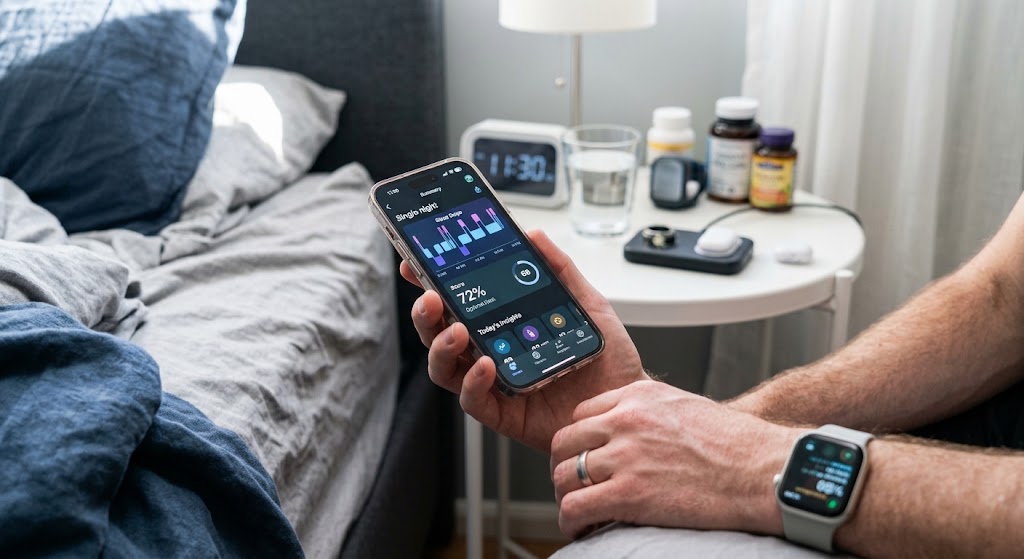
For millions of health-conscious adults, waking up no longer begins with taking an inventory of how the body actually feels. Instead, it begins with checking an algorithm: glancing at a smartwatch or smart ring to view an arbitrary readiness number or sleep stage breakdown.
When that score flashes an amber or red warning—indicating poor REM percentage or lower-than-average deep rest—a predictable psychological phenomenon occurs. Even if an individual wakes feeling relatively alert, the poor metric prompts subjective fatigue, brain fog, and midday irritability.
Behavioral sleep medicine specialists identify this data-induced preoccupation as a core driver of orthosomnia—a clinical state where the obsession with achieving perfect sleep tracker metrics directly induces or exacerbates insomnia.
Human sleep architecture is not a static exam that must be aced every 24 hours. The human nervous system is adaptive, dynamic, and cyclical.
Evaluating sleep requires shifting the lens away from the volatility of single nights and looking closely at multi-week, long-term trends.
#
The Flaw in Daily Biometric Tracking
Understanding why single-night fixations fail requires examining both consumer technology limitations and basic human neurobiology.
| Measurement Factor | Clinical Reality |
|---|---|
| Device Staging Accuracy | Wearables use movement & PPG heart rate algorithms, matching gold-standard polysomnography (PSG) only 50–65% of the time for sleep stages (REM vs. Deep). |
| Nightly Biological Flux | Acute variables (late digestion, evening hydration, normal immune responses) cause benign 24-hour fluctuations in HRV and resting heart rate. |
| The Digital Nocebo Effect | Learning of a "bad" metric induces pre-bed performance anxiety, raising nocturnal cortisol and delaying sleep. |
When individuals treat these estimated nightly readings as an objective diagnosis of their physiological health, they engage in unnecessary worry.
Polysomnography (PSG)—the clinical gold standard conducted in sleep laboratories—measures continuous electroencephalography (EEG) brainwave patterns, ocular activity, and electromyography.
Consumer wearables simply track wrist movement (actigraphy) and photoplethysmography (optical pulse data).
Chasing precise deep-sleep minute targets based on consumer algorithms is scientifically unsupported.
#
Understanding Cumulative Sleep Debt vs. Single-Night Deficits
Sleep architecture functions like an ongoing biological account balance rather than an isolated daily ledger:
#
Acute Deprivation vs. Homeostasis
A solitary night of disrupted rest—whether due to travel, noise, or late work—does not compromise long-term cardiovascular health or accelerate cognitive decline.
The human body naturally compensates the subsequent evening by increasing slow-wave sleep (N3 deep sleep) density through homeostatic sleep pressure (Process S).
#
The 14-Day Cumulative Curve
Sleep debt becomes clinically meaningful when deficits persist consistently over rolling two-week intervals.
Carrying a 45-to-60-minute nightly deficit across ten consecutive days noticeably degrades psychomotor vigilance and prefrontal cortex function, even if the person subjectively feels adapted.
#
Rolling Averages: 7- to 14-Day Metrics
Evaluating weekly sleep duration, consistent sleep-wake timing (circadian anchors), and monthly resting heart rate trends provides genuine insight into recovery capacity, eliminating the false alarms triggered by day-to-day noise.
#
4 Grounded Protocols to Reframe Your Sleep Health
To build sustainable, anxiety-free sleep patterns, incorporate these evidence-based habits:
#
1. Cover Your Data Until Midday
The Blind Tracking Method
If you wear a biometric tracker, avoid opening the app until after lunch.
Spend the first four hours of your day assessing your alertness through genuine interoception:
Do I need caffeine to function? How is my natural focus?
This breaks the digital nocebo cycle.
#
2. Prioritize Circadian Midpoints and Regularity Over Total Minutes
Consistency in your wake time anchors the master suprachiasmatic nucleus clock far more effectively than agonizing over whether you logged 7.2 or 7.8 hours.
Aim to keep your wake time within a 45-minute window seven days a week.
#
3. Audit Monthly Sleep Debt Trends
Review wearable data strictly every 14 to 30 days.
Look exclusively at two markers:
Average time asleep across the full cycle and resting heart rate (RHR) stability.
If your multi-week average sits within healthy adult ranges (typically 7 to 9 hours), single off-nights are clinically inconsequential.
#
4. Support Evening Downregulation Naturally
Optimize your sleep foundation by establishing an evening buffer zone:
- Dimming overhead LED lighting 90 minutes before bed.
- Keeping the bedroom temperature between 18°C and 20°C (65°F to 68°F).
- Ensuring adequate dietary mineral balance through leafy greens, seeds, or bioavailable magnesium supplements to support cellular relaxation.
#
References & Scientific Literature
- Baron, K. G., Abbott, S., Jao, N., Manalo, N., & Mullen, R. (2017). Orthosomnia: Are Some Patients Taking the Quantified Self Too Far? Journal of Clinical Sleep Medicine, 13(2), 351–354.
- Rosman, L., et al. (2021). Wearable Devices and Psychological Wellbeing: Are We Creating Health Anxiety? Circulation: Cardiovascular Quality and Outcomes, 14(8), e008169.
- Van Dongen, H. P., Maislin, G., Mullington, J. M., & Dinges, D. F. (2003). The Cumulative Cost of Additional Wakefulness: Dose-response effects on neurobehavioral functions and sleep physiology via chronic sleep restriction and total sleep deprivation. Sleep, 26(2), 117–126.
- De Zambotti, M., Cellini, N., Goldstone, A., Colrain, I. M., & Baker, F. C. (2019). Wearable Sleep Technology in Clinical and Research Settings: Current status and future trends. Sleep Medicine Reviews, 44, 44–58.
- Depner, C. M., et al. (2019). Ad libitum Weekend Recovery Sleep Fails to Prevent Metabolic Dysregulation during Recurrent Sleep Restriction. Current Biology, 29(6), 957–967.
#
Medical & Professional Disclaimer
The information presented in this article is published strictly for educational, informational, and journalistic purposes and is not a substitute for clinical diagnosis, individualized medical assessment, or healthcare treatment.
Always consult a qualified physician, sleep specialist, or board-certified practitioner regarding chronic insomnia, persistent daytime sleepiness, or sleep-disordered breathing.
Never ignore professional medical counsel or alter clinical regimens based on readings derived from commercial tracking wearables.











WonderfulLife Community
Join the Conversation