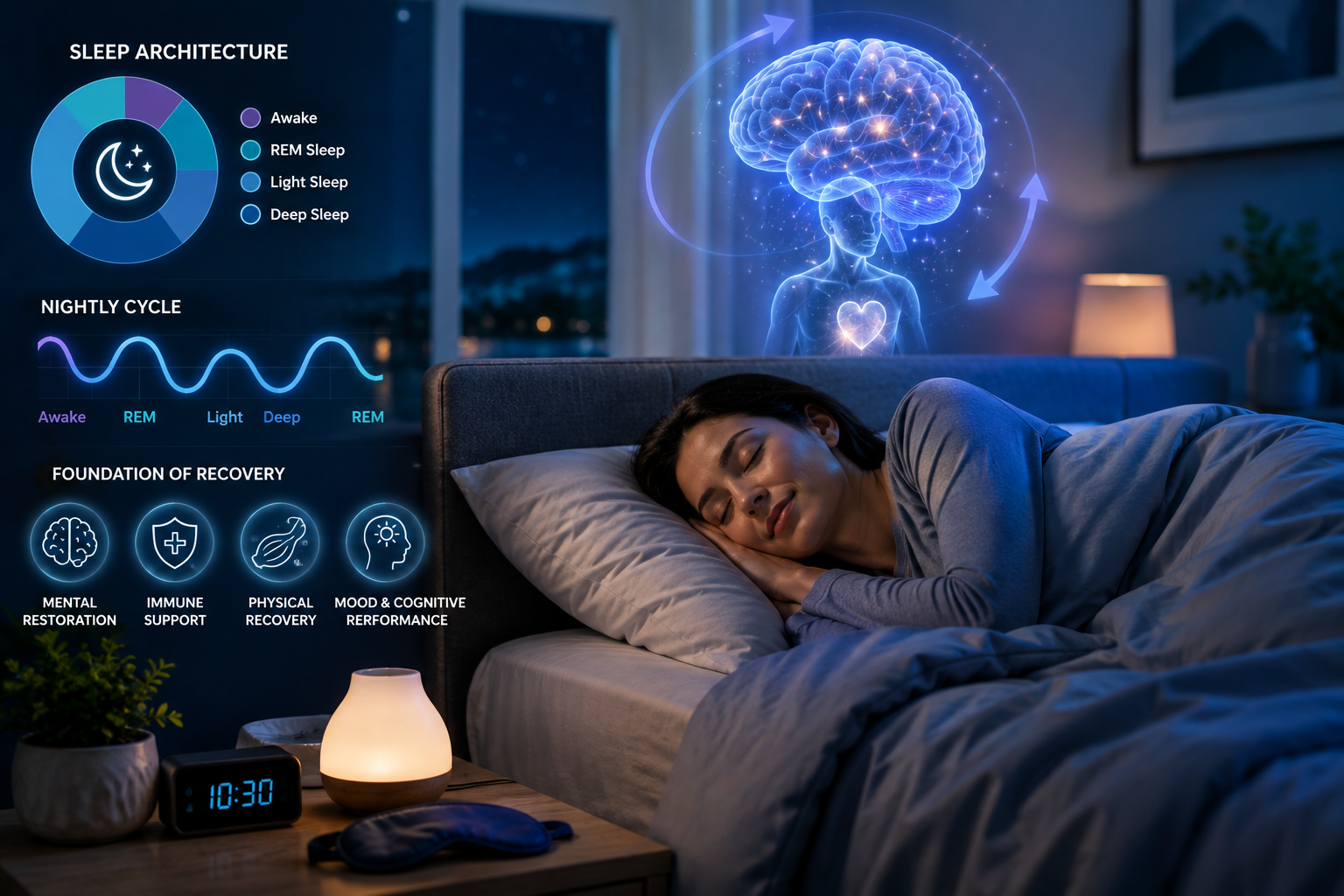
Sleep Architecture: How Deep Sleep, REM, and Circadian Rhythm Shape Restorative Sleep
Sleep may feel passive, but biologically it is anything but inactive.
Throughout the night, the brain and body move through a highly organized sequence of sleep stages that support recovery, memory, emotional regulation, immune function, metabolism, and overall health.
This structure is known as sleep architecture.
Understanding sleep architecture helps explain why good sleep is about more than simply spending a certain number of hours in bed.
The Two Major Types of Sleep
Normal sleep is divided into two broad states:
- Non-Rapid Eye Movement (NREM) sleep
- Rapid Eye Movement (REM) sleep
Across the night, the brain cycles repeatedly through these stages.
A typical sleep cycle often lasts roughly 90 to 120 minutes, but cycle length varies between individuals and changes across the night.
The proportion of time spent in each stage also shifts as the night progresses.
Earlier sleep periods generally contain more deep NREM sleep.
Later sleep periods usually contain more REM sleep.
NREM Sleep: From Light Sleep to Deep Sleep
NREM sleep includes several stages ranging from lighter sleep to deeper, slow-wave sleep.
Stage 1
This is the transition between wakefulness and sleep.
Muscle activity begins to relax, awareness of the environment fades, and the brain begins shifting into sleep.
Stage 2
Stage 2 sleep represents a large portion of the night.
Heart rate slows, body temperature begins to decrease, and characteristic brain-wave patterns known as sleep spindles and K-complexes appear.
This stage is not simply “light” or unimportant sleep.
It contributes to memory processing and normal sleep continuity.
Stage 3: Deep or Slow-Wave Sleep
Stage 3 is the deepest stage of NREM sleep.
It is more prominent during the earlier portion of the night.
During deep sleep:
- Brain-wave activity slows
- Heart rate and breathing are generally reduced
- Growth hormone secretion is associated with this stage
- Physical recovery processes continue
- Immune and metabolic regulation are supported
Deep sleep is often described as the body’s main physical-recovery stage.
That is a useful shorthand, but restoration occurs throughout sleep, not in one isolated stage.
Sleep and Growth Hormone
Growth hormone plays important roles in tissue maintenance, metabolism, and repair.
A substantial pulse of growth hormone often occurs during early-night slow-wave sleep.
This is one reason sleep is important for physical recovery.
However, it is too simplistic to say that deep sleep directly “repairs muscle micro-tears.”
Muscle recovery also depends on:
- Protein intake
- Training load
- Energy intake
- Hormonal status
- Age
- Recovery time
Sleep supports that system rather than acting alone.
The Glymphatic System: A Fascinating Area of Sleep Research
One of the most intriguing areas of sleep science involves the brain’s waste-clearance pathways.
Research in animals has shown that sleep can alter movement of fluid through brain tissue and may enhance clearance of certain metabolic byproducts.
This system is often referred to as the glymphatic system.
The concept has generated enormous scientific interest.
However, much of the mechanistic evidence comes from animal research, and scientists are still working to understand exactly how these processes operate in humans.
It is therefore better to say:
Sleep appears to support brain-fluid and waste-clearance processes, but the clinical implications are still being investigated.
REM Sleep: The Brain Becomes Highly Active
REM sleep is very different from deep NREM sleep.
During REM:
- Brain activity becomes more wake-like
- Most skeletal muscles become temporarily inhibited
- Dreaming is often vivid
- Emotional and memory-related processing continues
REM sleep becomes more prominent during the latter portion of a normal night.
That is one reason consistently cutting sleep short in the early morning can disproportionately reduce REM sleep.
What Does REM Sleep Do?
REM sleep is associated with processes involving:
- Memory consolidation
- Emotional processing
- Learning
- Neural plasticity
But it is too strong to say REM sleep alone is responsible for creativity, emotional stability, or problem-solving.
Different forms of memory and cognition appear to depend on interactions across multiple sleep stages.
Healthy sleep architecture requires the whole night.
Why Eight Hours in Bed Does Not Always Mean Eight Hours of Restorative Sleep
Time in bed and time asleep are not the same thing.
Sleep can be fragmented by:
- Noise
- Pain
- Stress
- Alcohol
- Sleep apnea
- Restless legs
- Medications
- Temperature
- Repeated awakenings
- Circadian misalignment
Someone may spend eight hours in bed and still wake feeling unrefreshed if sleep is repeatedly disrupted.
This is why sleep quality, continuity, timing, and duration all matter.
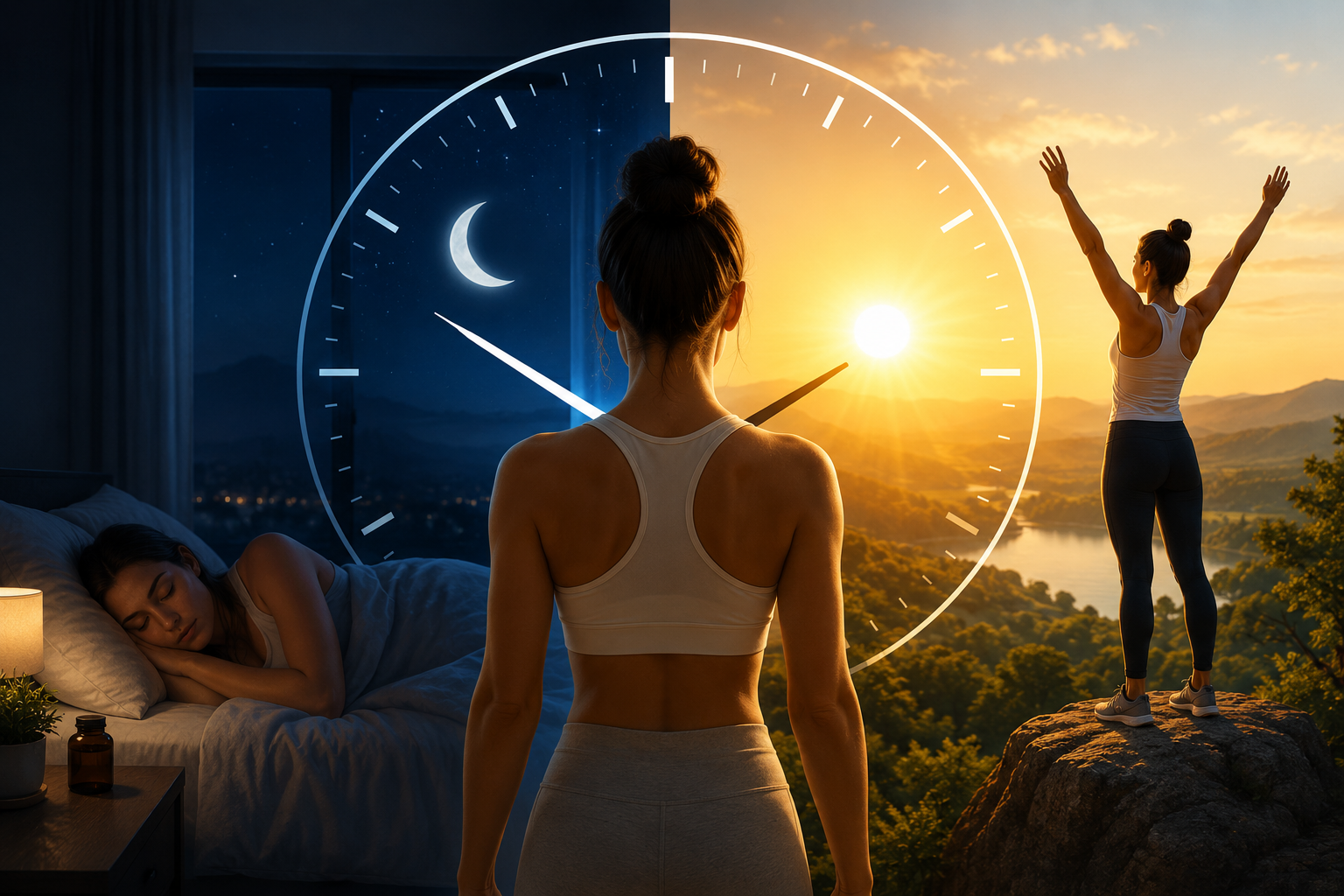
Two Biological Systems Regulate Sleep
One of the most useful models of sleep regulation is the two-process model.
It describes two interacting systems:
- Process C: Circadian timing
- Process S: Homeostatic sleep pressure
Together, they help determine when we feel alert and when we feel sleepy.
- Process C: Your Circadian Clock
The brain contains a central biological clock located in the suprachiasmatic nucleus, or SCN.
This clock helps coordinate daily rhythms in:
- Sleep and wakefulness
- Body temperature
- Hormonal activity
- Alertness
- Metabolism
Light is one of the strongest environmental signals affecting the circadian system.
Morning and daytime light help reinforce wake timing.
Evening darkness helps support the biological transition toward sleep.
Melatonin: A Signal of Biological Night
Melatonin is produced by the pineal gland primarily in response to the body’s internal circadian timing and darkness.
It is often called a “sleep hormone,” but it is more accurately thought of as a signal of biological night.
Melatonin helps communicate that the body has entered its nighttime phase.
It does not simply knock the brain unconscious.
Cortisol and Morning Alertness
Cortisol also follows a daily rhythm.
Many people experience a rise around waking, sometimes including a distinct cortisol awakening response.
This is part of normal circadian physiology.
But morning light does not simply “trigger cortisol” in a single direct step.
Light, circadian timing, sleep, stress, and individual biology all interact.
- Process S: Sleep Pressure
The longer we remain awake, the greater our drive for sleep becomes.
This is known as homeostatic sleep pressure.
One molecule involved in this process is adenosine.
Adenosine accumulates in the brain during waking hours and contributes to increasing sleepiness.
During sleep, this pressure gradually declines.
How Caffeine Works
Caffeine does not remove sleep pressure.
Instead, it blocks certain adenosine receptors.
This can temporarily reduce the sensation of sleepiness.
That is why caffeine can make someone feel more alert even though the underlying need for sleep has not disappeared.
As caffeine wears off, adenosine signaling becomes more noticeable again.
Why Late Caffeine Can Affect Sleep
Caffeine remains in the body for hours.
Its half-life varies greatly depending on:
- Genetics
- Pregnancy
- Medications
- Smoking
- Liver function
- Habitual intake
For people who struggle with sleep, moving caffeine earlier in the day can be a useful experiment.
There is no universal cutoff time that works for everyone.
Four Evidence-Informed Habits for Better Sleep
You do not need a complicated nighttime routine.
The strongest sleep habits are usually simple and consistent.
- Keep Sleep and Wake Times Reasonably Consistent
Regular timing helps reinforce circadian rhythms.
You do not need to go to bed and wake within an exact 30-minute window every single day.
Life is not that precise.
But large swings in timing—such as waking very early on weekdays and sleeping several hours later every weekend—can make circadian alignment more difficult.
A better goal is:
Keep your schedule reasonably consistent most of the time.
- Create a Dimmer Evening Environment
Bright evening light can delay circadian signaling and reduce melatonin production.
Screens can contribute, but the problem is not only “blue light.”
Screens also:
- Keep us mentally engaged
- Encourage bedtime procrastination
- Deliver emotionally stimulating content
- Extend the workday
Helpful habits include:
- Dimming overhead lights
- Lowering screen brightness
- Using night-mode settings
- Reducing work and stimulating content
- Choosing calmer activities before bed
There is no need to fear every screen after sunset.
The goal is simply to reduce unnecessary nighttime stimulation.
- Keep the Bedroom Comfortable and Cool
Body temperature naturally changes across the sleep-wake cycle.
Many people sleep better in a cool environment.
A commonly recommended range is around 18°C to 20°C (65°F to 68°F), but this is only a starting point.
The best temperature is the one that helps you sleep comfortably.
Also consider:
- Bedding
- Airflow
- Humidity
- Clothing
- Noise
- Light
Your bedroom should feel comfortable, not medically optimized.
- Build a Calming Wind-Down Routine
A wind-down routine can help create a psychological transition into sleep.
Examples include:
- Reading
- Gentle stretching
- Quiet music
- Warm tea
- A shower or bath
- Writing down tomorrow’s priorities
- Putting work away
The value comes from consistency and reduced stimulation.
What About Magnesium?
Magnesium is an essential mineral involved in:
- Nerve function
- Muscle function
- Energy metabolism
- Electrolyte balance
Some studies have investigated magnesium supplementation in people with insomnia or low magnesium intake.
Results are mixed.
Magnesium does not simply “bind to GABA receptors and switch off the brain.”
Its effects are more complex.
People who are deficient may benefit from correcting that deficiency.
But magnesium should not be treated as a universal sleep aid.
Magnesium Glycinate vs. Citrate
Different magnesium salts have different characteristics.
Magnesium Citrate
Often used because it is relatively soluble and can also have a laxative effect.
Magnesium Glycinate
Commonly marketed for good gastrointestinal tolerance.
Neither form is automatically superior for sleep.
The most appropriate form depends on:
- Individual tolerance
- Dose
- Reason for use
- Medical history
What About L-Theanine?
L-theanine is an amino acid found naturally in tea.
Research has explored its effects on relaxation, attention, and sleep-related outcomes.
Some findings are encouraging, but evidence is not strong enough to recommend it universally for sleep.
It is better considered an optional supplement than a foundational sleep strategy.
What About Herbal Tea?
Warm herbal tea can become a calming part of an evening routine.
Common options include:
- Chamomile
- Lemon balm
- Passionflower
- Peppermint
Part of the benefit may simply come from the ritual:
Warm drink + slower pace + reduced stimulation + a signal that the day is ending.
That can be valuable even when the pharmacological effect is modest.
Alcohol and Sleep Architecture
Alcohol can make people feel sleepy initially.
But sedation is not the same as restorative sleep.
Alcohol can:
- Fragment sleep later in the night
- Alter REM sleep
- Worsen snoring
- Aggravate sleep-disordered breathing
- Increase awakenings
For people trying to improve sleep quality, alcohol—particularly close to bedtime—is worth considering.
Exercise and Sleep
Regular physical activity can support healthy sleep.
Useful forms include:
- Walking
- Cycling
- Swimming
- Resistance training
- Yoga
- Gardening
Exercise can help reinforce circadian rhythms, support metabolic health, and improve overall sleep quality for many people.
The best timing varies.
Some people exercise well in the evening.
Others find intense late-night workouts too stimulating.
Individual response matters.
Don't Chase “More Deep Sleep”
Consumer wearables have made sleep stages feel like a scorecard.
People often worry because an app tells them they did not get enough deep sleep or REM.
But consumer devices estimate sleep stages indirectly.
They do not measure brain waves with the same accuracy as clinical polysomnography.
One night of “low deep sleep” on a watch is not a medical diagnosis.
Pay attention to broader signs:
Do you generally sleep enough? Do you wake reasonably refreshed? Can you function during the day?
Those matter too.
When Sleep Problems Need Professional Evaluation
Lifestyle habits can help many people.
But persistent sleep problems deserve attention.
Seek professional evaluation for:
- Chronic insomnia
- Loud habitual snoring
- Gasping or choking during sleep
- Witnessed breathing pauses
- Excessive daytime sleepiness
- Falling asleep while driving
- Restless legs
- Repeated unexplained awakenings
Conditions such as sleep apnea cannot be fixed with magnesium, blue-light filters, or a cooler bedroom.
The WonderfulLife Bottom Line
Restorative sleep is not about maximizing one particular stage.
It is about allowing the brain and body to move naturally through the full architecture of sleep.
Support that process with:
Enough time in bed. Reasonably consistent sleep timing. Daytime light exposure. Regular movement. A calmer evening environment. Thoughtful caffeine use. A comfortable bedroom. Less alcohol near bedtime.
Deep sleep matters.
REM sleep matters.
Light sleep matters too.
The body needs the entire sequence.
The goal is not to engineer perfect sleep.
The goal is to create the conditions that allow healthy sleep to happen naturally.
Scientific References & Sources
- Grandner, M. A. (2019). Sleep, health, and society. Sleep Medicine Clinics, 14(2), 151–164.
- Xie, L., et al. (2013). Sleep drives metabolite clearance from the adult brain. Science, 342(6156), 373–377.
- Irwin, M. R. (2015). Why sleep is important for health: A psychoneuroimmunology perspective. Annual Review of Psychology, 66, 143–172.
- Abbasi, B., et al. (2012). The effect of magnesium supplementation on primary insomnia in elderly: A double-blind clinical trial. Journal of Research in Medical Sciences, 17(12), 1161–1169.
Medical & Sleep Disclaimer
The information provided on WonderfulLife.ca is for educational, informational, and general wellness purposes only and is not intended as medical advice, diagnosis, or treatment.
Sleep needs and responses to supplements vary between individuals.
Persistent insomnia, excessive daytime sleepiness, loud snoring, witnessed breathing pauses, gasping during sleep, or other significant sleep symptoms may indicate an underlying sleep or medical disorder and should be professionally evaluated.
Magnesium, L-theanine, herbal supplements, and other sleep products can cause side effects or interact with medications and may not be appropriate for everyone.
Always consult with a physician, pharmacist, Registered Dietitian, qualified sleep professional, or other healthcare provider before beginning a new supplement or making major changes to a medical treatment plan.
Never disregard professional medical advice or delay seeking care because of information you have read on this website.
Credits
Author: WonderfulLife Editorial Team Editorial Assistance: Gemini Published For: WonderfulLife.ca









WonderfulLife Community
Join the Conversation