
The Microscopic Foundation of Human Vitality
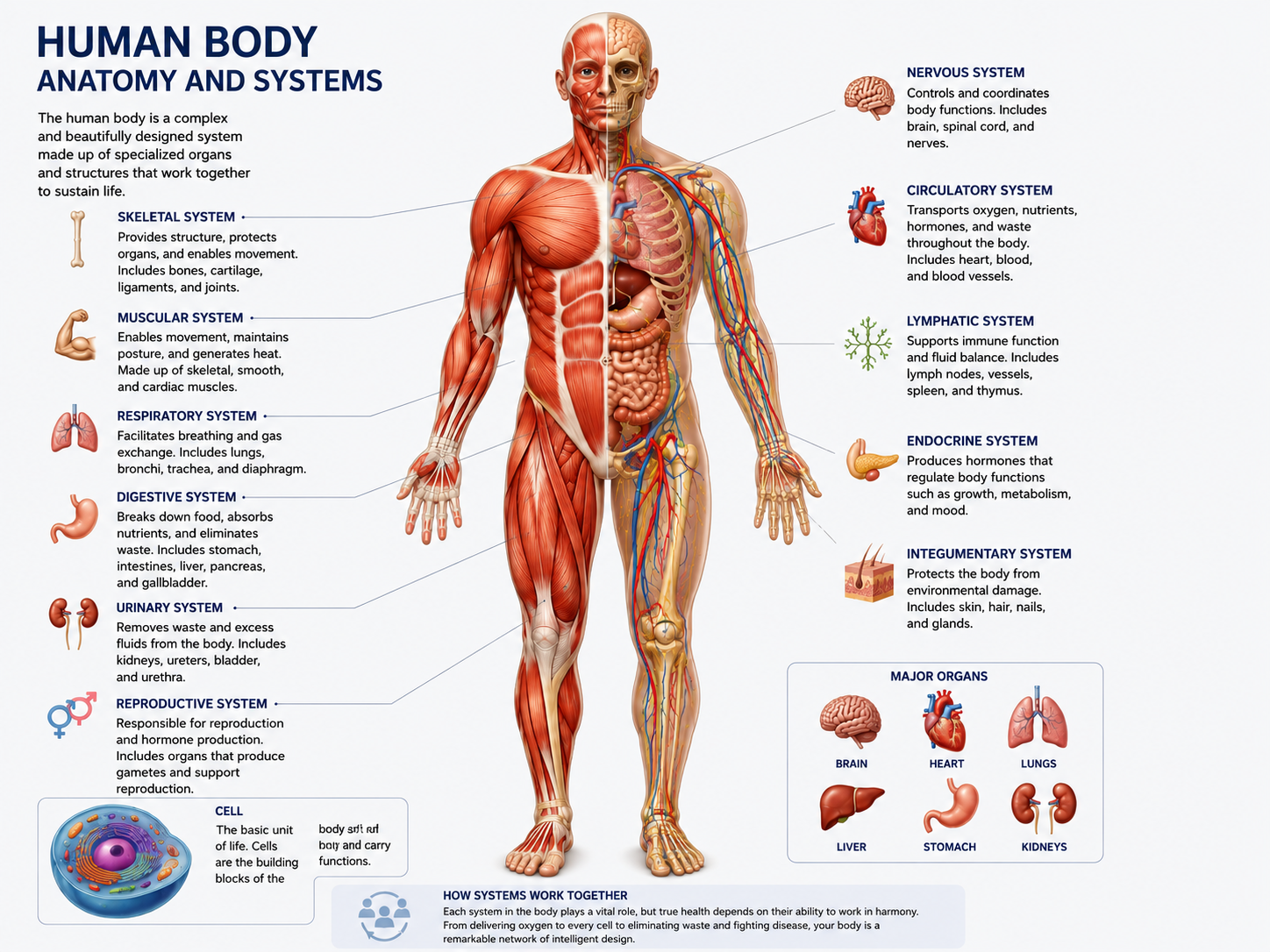
When we think about health, we usually think in broad terms: how much energy we have, how clearly we can focus, how well we move, how resilient we feel, or how effectively our cardiovascular and immune systems function.
Yet every one of those experiences begins at a much smaller scale.
The human body contains tens of trillions of cells working together in highly organized tissues, organs, and biological systems. Cells generate energy, build proteins, communicate with one another, respond to stress, repair damage, and help maintain the internal balance required for life.
This leads to an important principle:
Healthy tissues and organs depend on healthy cellular function.
That does not mean every health problem can be reduced to a single nutrient or cellular mechanism. Human biology is far more complex than that. But it does mean that nutrition matters partly because nutrients participate directly in the biochemical processes occurring inside our cells every moment of the day.
From Deficiency Prevention to Optimal Nutrition
One of the most important distinctions in nutrition is the difference between preventing deficiency and supporting healthy physiological function.
Recommended Dietary Allowances, or RDAs, are designed to meet the nutritional requirements of nearly all healthy people within specific age and sex groups.
They are not simply arbitrary "minimum survival levels."
At the same time, an RDA should not automatically be interpreted as the ideal intake for every individual, every circumstance, or every health objective.
Nutritional requirements can vary according to:
- Age
- Pregnancy and lactation
- Health status
- Dietary pattern
- Medication use
- Absorption
- Genetics
- Physical activity
- Environmental and lifestyle factors
Severe nutrient deficiencies illustrate how essential micronutrients are to human biology.
For example:
- Vitamin C deficiency can eventually cause scurvy.
- Vitamin D deficiency can impair normal bone mineralization.
- Thiamine deficiency can cause beriberi.
- Niacin deficiency can lead to pellagra.
These conditions demonstrate what happens when essential biochemical pathways are deprived of necessary nutrients.
But modern nutritional research asks a broader question:
What patterns of nutrient intake best support normal metabolism, healthy aging, and long-term physiological resilience?
The answer is not always as simple as "more is better."
The Micronutrient Network
Every living cell depends on thousands of coordinated chemical reactions.
Many of those reactions require vitamins and minerals as cofactors—molecules that help enzymes perform their biological functions.
Rather than operating independently, micronutrients often work as part of interconnected metabolic networks.
Mitochondrial Energy Production
Mitochondria help convert energy from carbohydrates, fats, and amino acids into adenosine triphosphate (ATP), the form of chemical energy cells can readily use.
This process depends on numerous micronutrients and metabolic cofactors.
B vitamins participate extensively in energy metabolism, while minerals such as magnesium are involved in hundreds of enzymatic reactions, including reactions associated with ATP.
Other compounds, including coenzyme Q10, also participate in mitochondrial energy transfer.
This does not mean taking larger quantities of these nutrients automatically produces more energy.
It means that adequate nutrient availability is necessary for normal metabolic pathways to function.
The Body's Antioxidant Defense Systems
Cells continuously generate reactive oxygen species as part of normal metabolism.
At controlled levels, these molecules can participate in cellular signaling. Problems arise when oxidative activity exceeds the body's capacity to regulate it.
The human body has several sophisticated antioxidant defense systems.
Important antioxidant enzymes include:
- Superoxide dismutase
- Catalase
- Glutathione peroxidase
These systems depend on a variety of nutrients.
For example, selenium is associated with glutathione peroxidase activity, while zinc, copper, and manganese participate in different forms of superoxide dismutase.
Dietary antioxidants and plant compounds can complement these endogenous defense networks.
Cell Membranes and Cellular Communication
Every cell is surrounded by a membrane composed largely of lipids and proteins.
These membranes are not simply protective walls.
They contain receptors, transporters, enzymes, and signaling structures that allow cells to:
- Receive hormonal signals
- Transport nutrients
- Maintain electrical gradients
- Communicate with neighboring cells
- Respond to changes in the surrounding environment
Fatty acids, phospholipids, cholesterol, proteins, and antioxidant systems all contribute to normal membrane function.
Good nutrition therefore supports more than individual biochemical reactions.
It helps maintain the structural environment in which cellular communication occurs.
Micronutrient Density: Quality Across the Whole Diet
The concept of micronutrient density refers to obtaining meaningful amounts of essential vitamins, minerals, and other beneficial food components without excessive calories.
Foods that contribute strongly to micronutrient density include:
- Vegetables
- Fruits
- Legumes
- Nuts and seeds
- Whole grains
- Eggs
- Fish
- Dairy or fortified alternatives
- Lean meats where appropriate
A nutrient-dense dietary pattern supplies dozens of compounds simultaneously.
This matters because human metabolism depends on networks of nutrients rather than one isolated vitamin or mineral.
Supplements may help fill specific nutritional gaps, but they should generally complement rather than replace a varied diet.
Bioavailability: Intake Is Only Part of the Story
Consuming a nutrient does not necessarily mean the entire amount reaches the bloodstream or tissues.
Bioavailability describes the proportion of a nutrient that becomes available for absorption and physiological use.
Bioavailability can be influenced by:
- Chemical form
- Food composition
- Digestive function
- Nutrient interactions
- Medication use
- Age
- Individual physiology
For example, different mineral salts can vary in solubility and absorption characteristics.
However, terms such as "oxide," "citrate," or "glycinate" do not by themselves establish whether a finished supplement is superior.
The appropriate form can depend on the nutrient, dose, formulation, intended use, and individual tolerance.
Chelated Minerals
Some minerals are bound to organic molecules, including amino acids or organic acids.
These compounds are commonly described as chelated minerals.
Chelation can affect factors such as stability, solubility, gastrointestinal tolerance, and absorption.
But bioavailability should ideally be evaluated using evidence for the specific mineral form and dose rather than broad assumptions that every chelated form is automatically superior.
Active and Coenzyme Vitamin Forms
Certain vitamins exist in several chemical forms.
Some supplement formulations use forms that are already biologically active or closely related to compounds used in metabolism.
This may be relevant in some circumstances, but the body is also highly capable of converting many dietary vitamin forms through normal metabolic processes.
The practical question is not whether a label uses the phrase "active vitamin."
It is whether the nutrient form, dose, formulation, and evidence are appropriate for the person using it.
Nutrient Synergy
Nutrition is inherently interactive.
Some nutrients influence the metabolism or function of others.
Examples include:
- Vitamin D and calcium in bone physiology
- Vitamin C and non-heme iron absorption
- Selenium and antioxidant enzyme systems
- Several B vitamins working together in energy metabolism
This is one reason balanced nutritional patterns are usually more meaningful than focusing on a single "hero nutrient."
The Three Foundations of Cellular Nutrition
A practical way to understand cellular nutrition is through three broad ideas:
Nourish
Provide the body with adequate energy, essential vitamins, minerals, amino acids, fatty acids, and other nutrients required for normal physiology.
Nutrition creates the biochemical foundation on which cellular processes depend.
Protect
Support the body's normal defense systems through nutrient sufficiency, antioxidant-rich foods, healthy metabolic function, and lifestyle choices that reduce unnecessary physiological stress.
Protection is not about eliminating every free radical.
It is about helping the body maintain a healthy balance between oxidation and antioxidant defense.
Renew
Cells continually repair, recycle, and replace damaged components.
Processes such as protein turnover, DNA repair, autophagy, mitophagy, and tissue regeneration all contribute to biological maintenance.
Nutrition helps provide the energy and raw materials required for these processes, while sleep, exercise, metabolic health, and other lifestyle factors also play essential roles.
Cellular Renewal and Autophagy
One of the most fascinating areas of modern biology involves autophagy, the cellular process through which cells break down and recycle certain damaged or unnecessary components.
A specialized form known as mitophagy helps regulate mitochondrial quality.
These processes are influenced by complex signaling networks involving nutrient availability, cellular energy status, exercise, fasting, stress responses, and genetics.
They should not be reduced to the idea that a particular nutrient simply "switches on cellular renewal."
The biology is much more sophisticated.
Building Health From the Inside Out
The idea of cellular nutrition is powerful because it reminds us that health is constructed through countless small biological processes repeated every day.
But cellular health does not come from a single nutrient, supplement, or molecular pathway.
It depends on an entire biological environment.
That environment is influenced by:
- Diet
- Physical activity
- Sleep
- Hydration
- Stress management
- Metabolic health
- Genetics
- Environmental exposures
- Medical care
Nutrition is one of the most important pieces because cells require a continuous supply of essential molecules to perform their normal functions.
The WonderfulLife Perspective
At WonderfulLife, we view cellular nutrition as a useful framework for understanding why everyday dietary choices matter.
The goal is not to chase extremely high doses of individual nutrients or assume that more supplementation always produces better cellular function.
Instead, the goal is to create nutritional sufficiency and balance.
Start with a nutrient-dense diet.
Identify genuine nutritional gaps.
Choose supplements thoughtfully when they are appropriate.
And evaluate nutritional products based on their formulation, evidence, manufacturing quality, and relevance to your individual needs.
The most important lesson from cellular biology is not that our cells require exotic intervention.
It is that they depend on remarkably complex systems—and those systems function best when the fundamentals of health are consistently supported.
References & Selected Bibliography
- Ames, B. N. (2006). Low micronutrient intake may accelerate the degenerative diseases of aging through allocation of scarce micronutrients by triage. Proceedings of the National Academy of Sciences, 103(47), 17589–17594.
- Wentz, M. W. (2002). Invisible Miracles: The Revolution in Cellular Nutrition. Medicis, S.C.
- Blumberg, J. B., Frei, B., Fulgoni, V. L., Weaver, C. M., & Zeisel, S. H. (2018). Impact of micronutrients on health and longevity: The difference between adequacy and optimal status. Nutrients, 10(6), 787.
- Holick, M. F. (2007). Vitamin D deficiency. New England Journal of Medicine, 357(3), 266–281.
- Sies, H. (2015). Oxidative stress: A concept in redox biology and medicine. Redox Biology, 4, 180–183.
- Levine, M., et al. Research concerning vitamin C requirements, pharmacokinetics, and physiological function.
Medical Disclaimer
The information provided in this article is for educational and informational purposes only and is not intended as medical advice, diagnosis, or treatment.
Nutrient requirements and supplement needs vary between individuals. More of a nutrient is not necessarily better, and excessive intake of some vitamins and minerals can cause adverse effects.
Always consult with a qualified healthcare professional before making significant changes to your diet, supplement routine, or medical care.









WonderfulLife Community
Join the Conversation