
Shifting from Restriction to Abundance
#
Introduction: Shifting from Restriction to Abundance
For decades, mainstream nutrition advice revolved around subtraction: cut carbs, eliminate fats, slash calories, or banish entire food groups.
While restrictive diets often trigger burnout and metabolic fatigue, modern microbiome science points to a far more sustainable and joyful principle: dietary diversity.
The human gut is home to roughly 38 trillion microorganisms, collectively weighing between one and two kilograms. This complex internal ecosystem does not thrive on monotonous health staples like plain chicken breast and steamed white rice. It flourishes when exposed to an expansive variety of plant fibers, complex carbohydrates, and protective polyphenols.
Instead of meticulously counting grams or feeling guilty over dietary omissions, nutritional researchers increasingly advocate for a simple, engaging benchmark: consuming 30 different plant species per week.
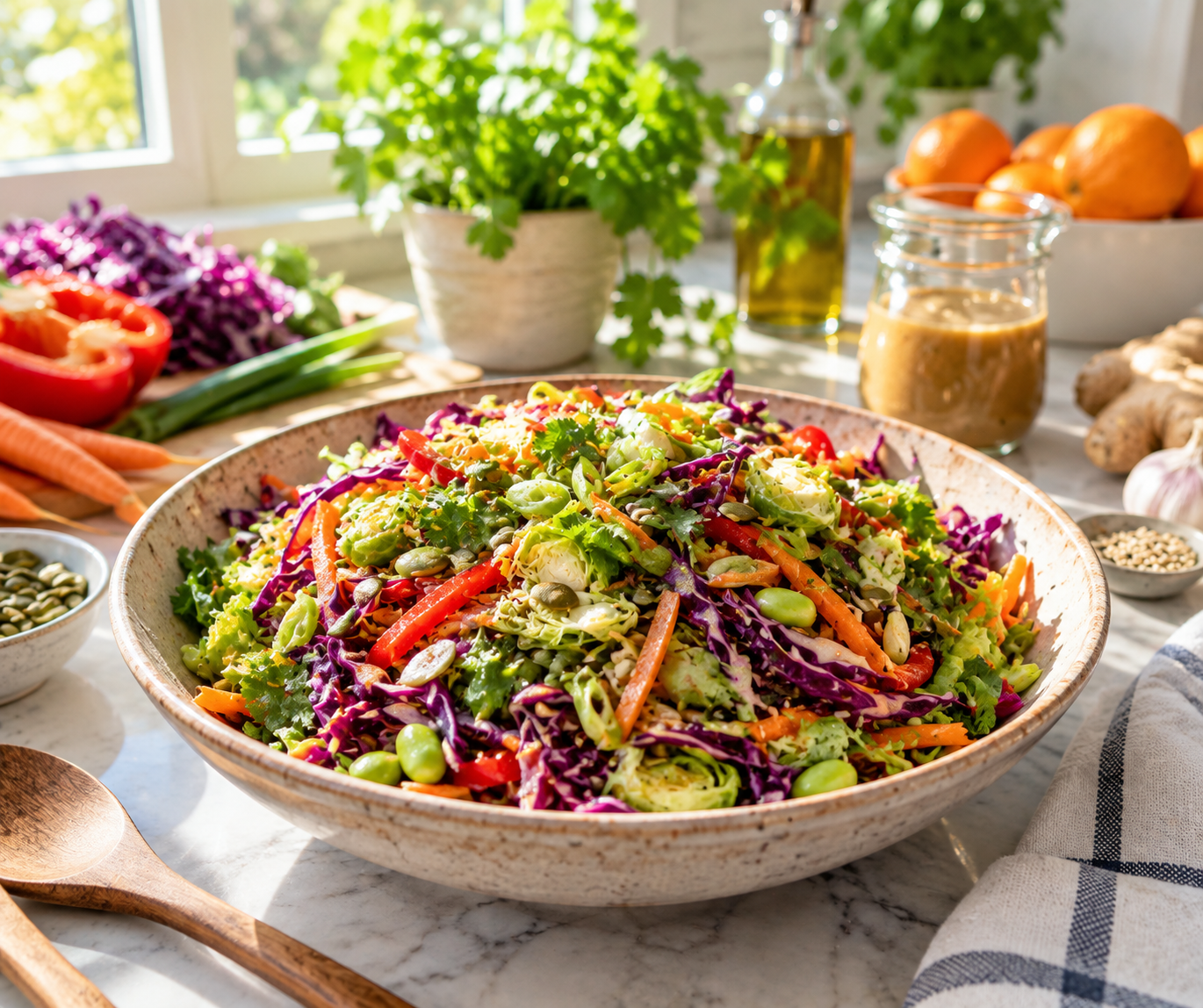
Building a single "Rainbow Crunch" Salad turns this scientific target into an effortless culinary ritual rather than a tedious tracking chore.
#
The Science: Why the "30 Plants" Benchmark Matters
The foundation of the 30-plant rule originates from the American Gut Project, the largest open-source citizen science microbiome initiative ever conducted, led by researchers at the University of California San Diego School of Medicine.
#
The 30-Plant Microbiome Cascade
1. Diverse Plant Intake Vegetables, grains, legumes, seeds, herbs, spices ↓ Provides distinct prebiotic substrates: inulin, pectin, resistant starch
2. Specialized Microbial Fermentation ↓ Proliferation of beneficial taxa: Bifidobacteria, Faecalibacterium prausnitzii
3. Robust Production of Short-Chain Fatty Acids (SCFAs) ↓ Acetate, Propionate, and Butyrate
4. Systemic Protection
- Strengthens intestinal mucosal barrier tight junctions
- Modulates peripheral immune response and reduces systemic inflammation
- Communicates via the gut-brain axis to support cognitive clarity
Analyzing the stool samples of more than 10,000 individuals across the United States, United Kingdom, and Australia, researchers discovered that the single strongest predictor of a healthy, diverse gut microbiome was not whether a participant identified strictly as vegan, vegetarian, or omnivore.
Rather, it was the sheer variety of plants they consumed.
Individuals who consumed more than 30 distinct plants weekly harbored significantly more diverse microbial populations—particularly species like Faecalibacterium prausnitzii, which ferment fiber into butyrate, a primary fuel source for colonocytes that reinforces gut barrier integrity and mitigates systemic inflammation.
Conversely, those consuming 10 or fewer plant types per week displayed lower diversity and elevated markers of antibiotic-resistant genes.
#
Redefining What Counts as a "Plant"
Hitting 30 plant varieties sounds daunting only if you define "plants" strictly as heads of lettuce or stalks of broccoli.
In nutritional science, the plant kingdom spans six distinct categories:
| Category | Example Varieties | Typical Serving Contribution |
|---|---|---|
| Leafy & Cruciferous Vegetables | Red cabbage, lacinato kale, arugula, radish | 1 point per variety |
| Legumes & Pulses | Edamame, chickpeas, black lentils, navy beans | 1 point per variety |
| Nuts & Seeds | Pumpkin seeds (pepitas), chia seeds, slivered almonds | 1 point per variety |
| Whole Grains | Quinoa, farro, wild rice, buckwheat | 1 point per variety |
| Fresh Herbs | Cilantro, flat-leaf parsley, mint, chives | 1 point per variety |
| Roots, Aromatics & Spices | Ginger, garlic, turmeric, sesame seeds | 1 point per variety |
A single complex dressing made with grated ginger, crushed garlic, sesame oil, and apple cider vinegar alone contributes multiple plant points before you even dress the greens.
The Recipe: The 15-Plant Rainbow Crunch Salad
This vibrant, textured salad delivers 15 distinct plants in a single bowl, getting you halfway to your weekly goal in one meal.
Because it relies on sturdy cruciferous vegetables rather than delicate greens, it holds its crunch in the refrigerator for up to three days without turning soggy.
#
The Rainbow Crunch Plant Count
#
Salad Base
- Red cabbage
- Shaved Brussels sprouts
- Orange carrots
- Red bell pepper
- Shelled edamame
- Cilantro
- Green onions (scallions)
- Raw pumpkin seeds (pepitas)
#
Ginger-Miso Sesame Dressing
- Extra virgin olive oil (olives)
- Toasted sesame oil (sesame)
- Apple cider vinegar (apples)
- White miso (fermented soybeans)
- Fresh ginger root
- Fresh garlic
- Pure maple syrup (maple sap)
#
Total: 15 Distinct Botanical Species
#
Ingredients
#
The Crunchy Base
- 2 cups thinly shredded red cabbage
- 1.5 cups shaved Brussels sprouts
- 1 large carrot, julienned or shredded
- 1 red bell pepper, thinly sliced into matchsticks
- 1 cup organic shelled edamame (steamed and cooled)
- 1/2 cup fresh cilantro leaves, coarsely chopped
- 3 green onions, thinly sliced (white and green parts)
- 1/3 cup raw pumpkin seeds (pepitas), lightly toasted in a dry skillet
#
The Living Ginger-Miso Dressing
- 3 tbsp extra virgin olive oil
- 1 tbsp toasted dark sesame oil
- 2 tbsp raw, unfiltered apple cider vinegar
- 1.5 tbsp mellow white miso paste
- 1 tbsp freshly grated ginger root
- 1 clove garlic, finely grated or minced
- 1 tsp pure maple syrup
- 1–2 tbsp warm water (to loosen to dressing consistency)
#
Preparation Steps
#
1. Whisk the Dressing
In a glass measuring cup or small bowl, whisk together the white miso, grated ginger, minced garlic, maple syrup, and apple cider vinegar until smooth.
Slowly stream in the olive oil and toasted sesame oil while whisking. Add 1 to 2 tablespoons of warm water until it reaches a rich, pourable consistency.
#
2. Assemble the Base
In a large mixing bowl, combine the shredded red cabbage, shaved Brussels sprouts, julienned carrot, sliced red bell pepper, edamame, and scallions.
#
3. Dress and Massage
Pour two-thirds of the dressing over the vegetables.
Using clean hands or salad tongs, massage the dressing firmly into the cruciferous base for 60 seconds.
This lightly breaks down tough plant cell walls, tenderizing the vegetables while preserving their crisp texture.
#
4. Finish and Garnish
Fold in the chopped cilantro and toasted pumpkin seeds just before serving to maintain their maximum aromatic punch and crunch.
#
References & Scientific Literature
- McDonald, D., et al. (2018). American Gut: an Open Platform for Citizen Science Microbiome Research. mSystems, 3(3), e00031-18.
- Sonnenburg, E. D., & Sonnenburg, J. L. (2014). Starving Our Microbial Self: The Deleterious Consequences of a Diet Deficient in Microbiota-Accessible Carbohydrates. Cell Metabolism, 20(5), 779–786.
- Valdes, A. M., Walter, J., Segal, E., & Spector, T. D. (2018). Role of the gut microbiota in nutrition and health. BMJ, 361, k2179.
- Koh, A., De Vadder, F., Kovatcheva-Datchary, P., & Bäckhed, F. (2016). From Dietary Fiber to Host Physiology: Short-Chain Fatty Acids as Key Bacterial Metabolites. Cell, 165(6), 1332–1345.
- Heiman, M. L., & Greenway, F. L. (2016). A healthy gastrointestinal microbiome is dependent on dietary diversity. Molecular Metabolism, 5(5), 317–320.
#
Medical & Professional Disclaimer
The contents of this article and recipe are intended strictly for educational, nutritional, and informational purposes and should not be considered medical nutrition therapy or personalized dietary diagnosis.
Individuals managing irritable bowel syndrome (IBS), small intestinal bacterial overgrowth (SIBO), gastrointestinal narrowing, or severe food allergies should consult their gastroenterologist or a registered dietitian before rapidly increasing their intake of high-FODMAP vegetables, legumes, or raw cruciferous fibers.









WonderfulLife Community
Join the Conversation