Coenzyme Q10: Cellular Energy, Mitochondria, and Healthy Aging
Every second of every day, your cells require energy.
Walking, thinking, breathing, maintaining body temperature, contracting muscles, transmitting nerve signals, and repairing tissues all depend on a steady supply of usable cellular energy.
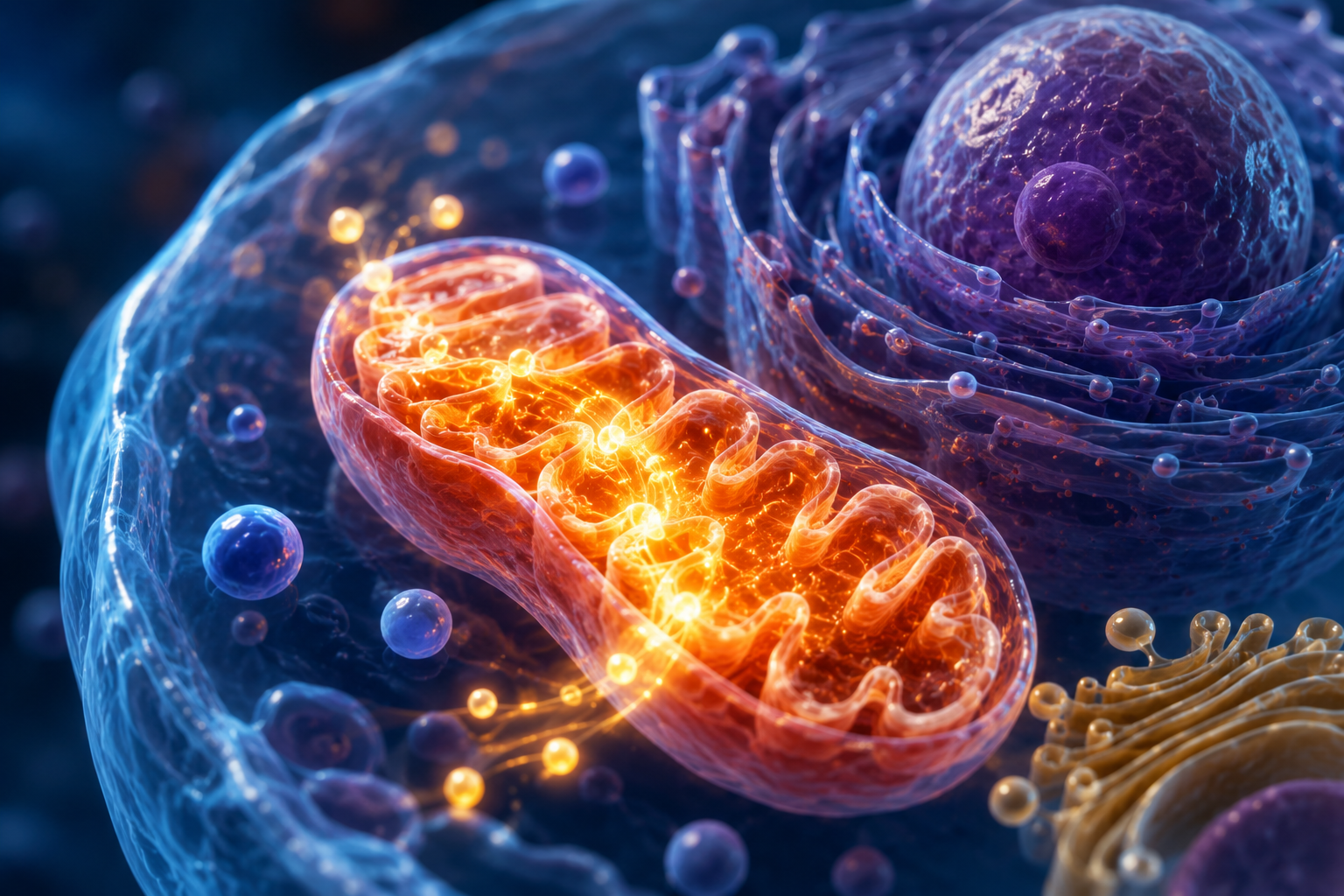
Much of that energy is produced inside specialized structures called mitochondria.
Mitochondria convert energy derived from food into adenosine triphosphate (ATP), the chemical energy currency used throughout the body.
One molecule plays an especially important role in this process:
Coenzyme Q10, or CoQ10.
What Is CoQ10?
CoQ10 is a naturally occurring, fat-soluble compound found throughout the body.
It is especially abundant in tissues with high energy requirements, including:
- Heart
- Liver
- Kidneys
- Skeletal muscle
CoQ10 exists primarily in two interconvertible forms:
- Ubiquinone, the oxidized form
- Ubiquinol, the reduced form
The body continually converts one form into the other as part of normal cellular metabolism.
Unlike an essential vitamin, CoQ10 can be synthesized by the human body.
It is also obtained in small amounts from food.
CoQ10 and the Mitochondrial Energy System
Inside mitochondria is a highly organized group of proteins known as the electron transport chain.
This system helps convert energy from nutrients into ATP.
CoQ10 acts as an electron carrier within the inner mitochondrial membrane, helping transfer electrons between parts of this system.
That makes CoQ10 essential to normal mitochondrial energy production.
Without adequate CoQ10, mitochondrial energy metabolism cannot function normally.
But this does not mean that taking more CoQ10 automatically creates more energy.
For a person with adequate CoQ10 status, supplementation may not noticeably improve everyday energy or athletic performance.
CoQ10 Is Also an Antioxidant
CoQ10 has another important function.
In its reduced form, ubiquinol can participate in antioxidant defense within lipid-containing environments such as cell membranes.
It can help limit oxidative reactions involving membrane lipids and lipoproteins.
CoQ10 also interacts with other antioxidant systems, including vitamin E.
This makes it interesting because it participates in both:
Energy metabolism
and
antioxidant biology.
Does CoQ10 Decline With Age?
Research suggests that CoQ10 concentrations can differ according to:
- Age
- Tissue type
- Health status
- Diet
- Medications
- Metabolic conditions
Some studies have reported age-related changes in CoQ10 status.
However, it is too simplistic to say that everyone experiences a predictable decline beginning at a particular age and that this directly causes fatigue or slower recovery.
Fatigue is influenced by many factors, including:
- Sleep
- Anemia
- Thyroid function
- Cardiovascular health
- Medications
- Nutrition
- Mental health
- Physical activity
CoQ10 should not be treated as a universal explanation for low energy.
Statins and CoQ10
One medication class deserves special attention:
Statins.
Statins lower cholesterol partly by inhibiting the mevalonate pathway.
That same biochemical pathway is involved in the body's synthesis of CoQ 1
As a result, statin therapy can reduce circulating CoQ10 concentrations.
Researchers have investigated whether CoQ10 supplementation may help some people experiencing statin-associated muscle symptoms.
Results are mixed.
Some studies report benefit.
Others do not.
Anyone experiencing muscle pain or weakness while taking a statin should discuss it with their healthcare professional rather than stopping medication or self-treating with supplements.
- CoQ10 and Heart Health
The heart has extraordinarily high energy requirements.
Cardiac muscle contracts continuously throughout life, making mitochondrial energy metabolism critically important.
This biological connection has led researchers to study CoQ10 in cardiovascular disease.
Heart Failure Research
One of the better-known clinical trials is Q-SYMBIO, which examined CoQ10 supplementation in people with chronic heart failure.
The study reported encouraging outcomes in selected patients receiving CoQ10 alongside standard medical therapy.
However, several important points must remain clear:
CoQ10 is not a replacement for heart-failure medication.
Evidence from heart-failure patients does not mean every healthy adult needs CoQ10 for heart health.
Cardiovascular treatment should always be individualized.
CoQ10 remains an interesting adjunctive area of research rather than a universal cardiovascular prescription.
Blood Pressure and Endothelial Function
Researchers have also studied CoQ10 in relation to:
- Blood pressure
- Endothelial function
- Oxidative stress
Some trials and reviews report modest improvements in certain measures.
Other studies show smaller or inconsistent effects.
This is another area where the evidence is promising but not strong enough to claim that CoQ10 reliably lowers blood pressure or improves circulation in everyone.
- CoQ10 and Physical Energy
Because CoQ10 participates directly in ATP production, it is easy to assume that supplements must improve physical stamina.
The evidence is much less straightforward.
Some studies have examined CoQ10 supplementation in:
- Athletes
- Older adults
- People with mitochondrial disorders
- People with fatigue-related conditions
Results vary.
People with specific medical conditions affecting mitochondrial function may have very different needs from healthy adults.
For the average person, foundational factors such as:
- Sleep
- Fitness
- Nutrition
- Iron status
- Hydration
- Medical health
are much more likely to determine everyday energy than simply adding CoQ10.
- CoQ10 and Healthy Aging
Mitochondrial function changes with age.
Oxidative balance also changes over time.
Because CoQ10 participates in both mitochondrial energy metabolism and antioxidant systems, researchers have investigated its possible relevance to aging.
That research is biologically interesting.
But “anti-aging supplement” would be too strong a label.
Healthy aging depends on far more than mitochondrial antioxidants.
The foundations remain:
- Regular movement
- Resistance training
- Nutrient-dense food
- Healthy blood pressure
- Good sleep
- Avoiding smoking
- Metabolic health
- Social connection
- Appropriate medical care
CoQ10 may complement those foundations in specific circumstances.
It cannot replace them.
Food Sources of CoQ10
The body produces most of its CoQ10 internally, but food contributes small amounts.
Sources include:
- Organ meats
- Beef
- Pork
- Fatty fish
- Chicken
- Nuts
- Seeds
- Certain vegetable oils
Diet alone generally provides much less CoQ10 than typical supplement doses.
That does not automatically mean supplementation is necessary.
The body normally synthesizes CoQ10 as part of its own metabolism.
Ubiquinone vs. Ubiquinol
One of the most common supplement questions is:
Which form is better?
Ubiquinone
Ubiquinone is the oxidized form of CoQ 1
It has been used in many clinical studies and has a long history in supplementation research.
Ubiquinol
Ubiquinol is the reduced form.
It may produce higher circulating CoQ10 levels in some formulations and individuals.
However, the body readily interconverts ubiquinone and ubiquinol.
That means it is too simplistic to call ubiquinol the “active” form and ubiquinone the “inactive” form.
Both participate in the normal CoQ10 cycle.
Formulation May Matter as Much as Form
CoQ10 is poorly soluble in water.
This makes formulation important.
Manufacturers may use:
- Oil-based softgels
- Solubilized formulations
- Emulsions
- Other delivery technologies
The exact formulation can influence absorption.
For that reason, comparing ubiquinone vs. ubiquinol without considering the delivery system can be misleading.
Should Co
Q10 Be Taken With Food?
Because CoQ10 is fat-soluble, taking it with a meal containing some dietary fat can improve absorption in many circumstances.
Examples might include a meal containing:
- Olive oil
- Avocado
- Nuts
- Eggs
- Fish
- Other healthy fats
Some supplements are already formulated in oil-based softgels.
Follow the product instructions unless your healthcare professional recommends otherwise.
What About Alpha-Lipoic Acid?
Alpha-lipoic acid is another compound involved in cellular energy metabolism and antioxidant biology.
It is sometimes marketed together with CoQ10 as a “mitochondrial antioxidant combination.”
The biological rationale is interesting.
But there is not strong evidence that every healthy person benefits from combining supplemental CoQ10 with alpha-lipoic acid.
Alpha-lipoic acid can also affect blood glucose and interact with medications.
It should therefore be considered according to individual needs rather than automatically paired with CoQ10.
How to Evaluate a CoQ10 Supplement
If you choose to use CoQ10, look beyond marketing language.
Consider:
Clearly Stated Dose
The label should specify how much CoQ10 is provided per serving.
Identified Form
The product should state whether it contains ubiquinone or ubiquinol.
Appropriate Delivery System
Because CoQ10 is fat-soluble, formulation matters.
Manufacturing Quality
Look for transparent manufacturing standards and appropriate quality controls.
Independent Verification
Third-party testing can provide additional confidence regarding identity, purity, and label accuracy when the certification applies to the specific product.
More Is Not Always Better
Higher doses do not automatically produce greater benefits.
CoQ10 is generally well tolerated in many adults, but supplements can cause side effects such as:
- Digestive discomfort
- Nausea
- Appetite changes
- Headache
It may also interact with certain medications.
The appropriate dose depends on why it is being used.
Important Medication Interactions
CoQ10 may interact with medications, including some anticoagulants such as warfarin.
People taking:
- Anticoagulants
- Blood-pressure medications
- Diabetes medications
- Multiple cardiovascular drugs
should discuss CoQ10 supplementation with a pharmacist or physician.
People receiving treatment for serious cardiovascular disease should never substitute CoQ10 for prescribed therapy.
The WonderfulLife Bottom Line
Coenzyme Q10 is one of the more fascinating molecules in nutritional biochemistry.
It sits at the intersection of:
Mitochondrial energy production
and
antioxidant defense.
That makes it scientifically important.
It also makes it easy to oversell.
CoQ10 is not a universal energy booster.
It is not an anti-aging cure.
And healthy people do not necessarily need a supplement simply because CoQ10 participates in ATP production.
Instead, ask:
Do I have a reason to supplement? Is the dose appropriate? Is the formulation well made? Could it interact with my medication? Does the evidence fit my situation?
For some people—particularly in certain medically supervised situations—CoQ10 may be useful.
For everyone else, the foundations of mitochondrial health remain reassuringly familiar:
Move your body. Build muscle. Eat well. Sleep enough. Protect cardiovascular health. Avoid smoking. Manage medical conditions appropriately.
Mitochondria need more than one nutrient.
They need a healthy body in which to work.
Scientific References & Sources
- Hargreaves, I. P. (2014). Coenzyme Q10 as a therapy for mitochondrial disease. International Journal of Biochemistry & Cell Biology, 49, 105–111.
- Mortensen, S. A., et al. (2014). The effect of coenzyme Q10 on morbidity and mortality in chronic heart failure: Results from Q-SYMBIO. JACC: Heart Failure, 2(6), 641–649.
- Gutiérrez-Mariscal, F. M., et al. (2019). Coenzyme Q10 and aging. Antioxidants, 8(5), 126.
- Arenas-Jal, M., Suñé-Negre, J. M., & García-Montoya, E. (2015). Coenzyme Q10 supplementation: Efficacy, safety, and formulation challenges. Comprehensive Reviews in Food Science and Food Safety, 14(5), 563–579.
Medical & Nutritional Disclaimer
The information provided on WonderfulLife.ca is for educational, informational, and general wellness purposes only and is not intended as medical advice, diagnosis, or treatment.
CoQ10 supplementation may not be appropriate for everyone and can interact with prescription medications.
People with cardiovascular disease, diabetes, blood-pressure disorders, mitochondrial disease, or those taking anticoagulants or other medications should consult with a physician, pharmacist, Registered Dietitian, or other qualified healthcare professional before beginning CoQ 1
Do not stop or alter prescribed cardiovascular or cholesterol medication based on information in this article.
Persistent fatigue, muscle weakness, reduced exercise tolerance, chest symptoms, or other significant health changes should be medically evaluated rather than assumed to result from low CoQ 1
Never disregard professional medical advice or delay seeking care because of information you have read on this website.
Credits
Author: WonderfulLife Editorial Team Editorial Assistance: Gemini Published For: WonderfulLife.ca






WonderfulLife Community
Join the Conversation