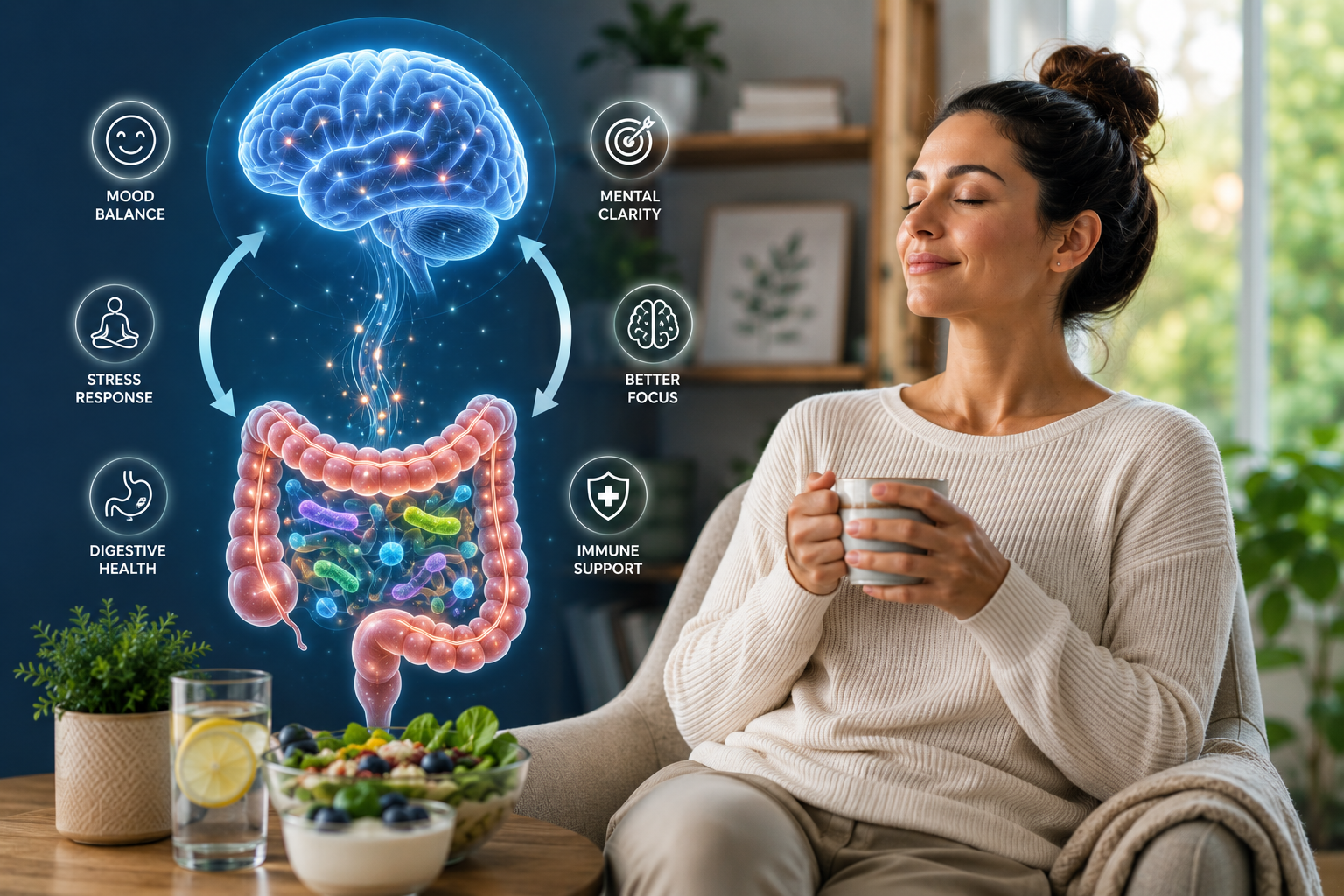
The Gut-Brain Axis: How Your Microbiome Communicates with Your Brain
Have you ever felt “butterflies” in your stomach before an important presentation?
Or noticed that stress can change your appetite, digestion, or bowel habits?
These familiar experiences illustrate something scientists now study intensively: the gut-brain axis.
The gut-brain axis is a complex, two-way communication network connecting the gastrointestinal system with the brain.
And the conversation goes in both directions.
Your brain can influence:
- Appetite
- Digestion
- Intestinal movement
- Gut sensitivity
- Stress responses
At the same time, signals originating in the gastrointestinal tract can influence neural, immune, hormonal, and metabolic pathways involved in overall health.
Adding another fascinating layer to this system is the gut microbiome—the enormous community of microorganisms living throughout the digestive tract.
Your Gut Is Much More Than a Digestive Tube
Embedded within the gastrointestinal tract is the enteric nervous system (ENS).
Sometimes informally called the “second brain,” the ENS contains hundreds of millions of nerve cells and helps coordinate many aspects of gastrointestinal function.
But it does not operate completely independently.
The enteric nervous system communicates continuously with the brain and spinal cord through neural, hormonal, immune, and metabolic pathways.
The microorganisms living in the gut also participate in this communication.
Gut microbes can:
- Metabolize components of food
- Ferment dietary fiber
- Produce short-chain fatty acids
- Interact with immune cells
- Modify bile acids
- Produce or influence biologically active compounds
Scientists are increasingly investigating how these activities may influence health far beyond digestion.
The Microbiome and Mental Health: An Important Distinction
Research has found associations between the gut microbiome and conditions involving mood, stress, and cognition.
But this field is still developing.
It would be premature to say that a particular microbiome directly creates happiness, prevents anxiety, or guarantees better concentration.
Human mental health is influenced by an enormous number of factors, including:
- Genetics
- Sleep
- Relationships
- Physical health
- Environment
- Stress
- Exercise
- Nutrition
- Medications
- Life experiences
The microbiome may be one contributor within this much larger system.
That makes the gut-brain connection fascinating—but not a simple explanation for every mood or cognitive symptom.
How Does the Gut Communicate with the Brain?
Scientists are studying several interconnected communication pathways.
- The Vagus Nerve: A Major Communication Route
The vagus nerve is one of the major neural communication pathways connecting the brain with organs in the chest and abdomen.
It carries signals in both directions.
Importantly, much of the information carried by the vagus nerve travels from the body toward the brain.
Signals originating in the gastrointestinal tract can therefore provide the brain with information about the internal environment.
Microbial activity may influence this system indirectly through:
- Metabolites
- Immune signaling
- Enteroendocrine cells
- Other chemical messengers
Animal studies have demonstrated particularly interesting relationships between gut microbes and vagal signaling.
Human research continues to investigate how important these mechanisms are in everyday health.
- Neurotransmitters and the Gut
One of the most fascinating areas of gut-brain research involves neurotransmitters.
Microorganisms can produce or influence compounds involved in nervous-system signaling.
But there is an important distinction:
A neurotransmitter produced in the gut does not necessarily travel directly into the brain and perform the same function there.
What About Serotonin?
You may have heard that approximately 90% of the body’s serotonin is produced in the gastrointestinal system.
That is broadly true.
Most peripheral serotonin is produced by specialized cells in the gut called enterochromaffin cells.
Gut microorganisms can influence aspects of this production.
But gut serotonin does not simply cross the blood-brain barrier and become brain serotonin.
Peripheral serotonin has important roles of its own, including functions related to:
- Gastrointestinal motility
- Platelets
- Vascular physiology
- Other peripheral processes
The relationship between the microbiome, serotonin biology, and the brain is considerably more complex than the popular phrase:
“Most of your happiness hormone is made in your gut.”
That statement is catchy—but scientifically misleading.
What About GABA?
Certain microorganisms can produce gamma-aminobutyric acid (GABA) or influence pathways related to it.
GABA is an important inhibitory neurotransmitter in the central nervous system.
Laboratory and animal research has generated considerable interest in whether microbial activity can influence GABA-related signaling.
However, bacterial production of GABA in the intestine should not be interpreted as meaning that gut-produced GABA simply enters the brain and creates a calming effect.
Scientists are investigating much more complex pathways involving:
- Neural communication
- Microbial metabolites
- Immune signaling
- Endocrine signaling
This is an exciting research area, but many questions remain unanswered.
- Short-Chain Fatty Acids: Messages Created From Fiber
One of the clearest examples of interaction between diet and the microbiome involves short-chain fatty acids, or SCFAs.
When certain gut bacteria ferment fermentable carbohydrates and dietary fibers, they produce compounds including:
- Acetate
- Propionate
- Butyrate
These compounds participate in several aspects of normal physiology.
Butyrate and the Intestinal Barrier
Butyrate is particularly interesting because cells lining the colon can use it as an important energy source.
SCFAs are also involved in:
- Intestinal-barrier function
- Immune regulation
- Metabolic signaling
- Gut physiology
This helps explain why fiber-rich foods can influence health partly through the microorganisms that metabolize them.
But avoid thinking of the intestinal barrier as simply “open” or “closed.”
Gut permeability is a regulated biological process, and claims about universally “healing leaky gut” should be treated cautiously.
- The Immune System Joins the Conversation
A large amount of immune activity occurs around the gastrointestinal tract.
That makes sense.
The intestinal surface must continuously distinguish among:
- Food components
- Resident microorganisms
- Potential pathogens
- Environmental compounds
The microbiome interacts extensively with this immune environment.
Researchers are investigating how changes in microbial communities and microbial metabolites may influence inflammatory signaling throughout the body.
This represents another possible pathway through which the gut and brain communicate.
But terms such as “systemic micro-inflammation causing brain fog” should not be presented as a universal explanation.
Brain fog is a nonspecific symptom with many possible causes.
How Can You Support a Healthy Gut-Brain Environment?
You do not need to “hack” your microbiome.
For most healthy people, the strongest starting point is surprisingly familiar:
Eat a varied diet. Consume enough fiber. Move regularly. Sleep well. Manage stress. Avoid unnecessary restrictions.
Several habits deserve particular attention.
- Eat a Diverse Range of Plant Foods
Different plants contain different combinations of:
- Fibers
- Resistant starches
- Polyphenols
- Vitamins
- Minerals
- Other bioactive compounds
Useful choices include:
Vegetables
- Onions
- Garlic
- Leeks
- Asparagus
- Broccoli
- Leafy greens
Fruits
- Berries
- Apples
- Pears
- Kiwi
- Bananas
Whole Grains
- Oats
- Barley
- Whole wheat
- Quinoa
Legumes
- Lentils
- Chickpeas
- Black beans
- Kidney beans
Nuts and Seeds
- Walnuts
- Almonds
- Chia seeds
- Flaxseeds
- Pumpkin seeds
Variety matters because different microorganisms can use different dietary substrates.
What About “30 Plants a Week”?
The idea of eating 30 or more different plant foods per week became popular partly through observational findings from microbiome research, including the American Gut Project.
It can be a fun way to encourage dietary diversity.
But 30 is not a medically established threshold separating a healthy microbiome from an unhealthy one.
Do not worry if you reach 22 one week and 31 the next.
The useful principle is:
Eat many different plants regularly.
- Feed Your Microbes With Prebiotic Foods
A prebiotic is a substrate selectively utilized by host microorganisms that confers a health benefit.
Foods containing potentially useful fermentable fibers include:
- Garlic
- Onions
- Leeks
- Oats
- Legumes
- Asparagus
- Certain bananas
You do not need a specialized “gut-health” food for every meal.
Ordinary whole foods can provide an excellent microbiome-supportive foundation.
- What About Probiotics?
Probiotics are live microorganisms that, when administered in adequate amounts, confer a health benefit on the host.
But there is an important principle:
Probiotic benefits are strain-specific.
You cannot assume that every species—or every product containing the same species—will produce identical effects.
For example:
Lactobacillus rhamnosus describes a species.
A particular probiotic product contains a specific strain within that species.
Clinical evidence should ideally match:
The strain + dose + health outcome being considered.
Do Healthy People Need a Daily Probiotic?
Not necessarily.
Some probiotics have evidence for particular digestive conditions and circumstances.
But there is not enough evidence to recommend that every healthy person take a multi-strain probiotic indefinitely for mood, cognition, or “optimal neurotransmitter signaling.”
Food and dietary diversity remain foundational.
People considering probiotics for a specific medical concern should discuss appropriate products with a healthcare professional.
- Slow Down When You Eat
Stress can influence gastrointestinal function through the autonomic nervous system.
That does not mean eating while stressed completely shuts down digestion.
But creating a calmer meal environment can still be worthwhile.
Try:
- Sitting down to eat
- Putting your phone aside
- Eating more slowly
- Chewing comfortably
- Paying attention to hunger and fullness
- Taking a few comfortable breaths before beginning
These habits can make eating more enjoyable and may help people become more aware of digestive comfort and appetite.
- Move Your Body Regularly
Physical activity is associated with numerous benefits relevant to both brain and gastrointestinal health.
Regular movement supports:
- Cardiovascular health
- Glucose regulation
- Mood
- Sleep
- Gastrointestinal motility
- Overall metabolic health
Research is also investigating how exercise influences microbiome composition and function.
You do not need extreme exercise.
Walking counts.
Gardening counts.
Cycling counts.
Resistance training counts.
Consistency matters more than perfection.
What About Omega-3 Fatty Acids?
EPA and DHA are long-chain omega-3 fatty acids found primarily in seafood and marine oils.
They play important roles in cell membranes and are extensively studied in cardiovascular and neurological health.
Research is also exploring relationships between omega-3 intake, inflammation, intestinal physiology, and the microbiome.
Good food sources include:
- Salmon
- Sardines
- Mackerel
- Trout
- Herring
Omega-3 supplements can be useful in certain circumstances, but they should not be presented as necessary for “repairing” the gut-brain axis.
What About L-Glutamine?
Glutamine is an amino acid used extensively throughout the body.
Cells lining the intestine can use glutamine as an energy substrate.
This biological fact has led to widespread marketing of L-glutamine supplements for “gut repair.”
The evidence is more nuanced.
The body normally produces glutamine, and protein-containing foods provide it as part of the diet.
Supplemental glutamine has important clinical applications in certain circumstances and continues to be studied in gastrointestinal conditions.
But there is not strong evidence that every healthy person needs L-glutamine supplementation to maintain the intestinal barrier.
Be Careful With “Gut Health” Marketing
The microbiome has become one of the most heavily marketed areas of wellness.
Products may promise to:
- Heal your gut
- Eliminate brain fog
- Fix your mood
- Balance your microbiome
- Reset digestion
- Repair leaky gut
Human biology is rarely that simple.
No single probiotic, powder, detox, or supplement can guarantee a “perfect microbiome.”
In fact, scientists still do not have one universal definition of what a perfect microbiome would look like.
Different healthy people can have very different microbial communities.
The WonderfulLife Bottom Line
Your gut and brain are not separate worlds.
They participate in a remarkable two-way biological conversation involving:
Nerves. Hormones. Immune signals. Microbial metabolites. Diet. Stress. Sleep. Movement.
The microbiome appears to be an important participant in that conversation.
But supporting gut-brain health does not require chasing every new microbiome trend.
Start with the fundamentals:
Eat a wide variety of plant foods. Get enough fiber. Move regularly. Protect your sleep. Create time for recovery. Use probiotics for evidence-based reasons rather than simply because they are fashionable.
The most exciting lesson from gut-brain science may also be one of the simplest:
Taking care of your digestive health is part of taking care of your whole body.
Scientific References & Sources
- Cryan, J. F., et al. (2019). The microbiota-gut-brain axis. Physiological Reviews, 99(4), 1877–2013.
2. Foster, J. A., & Mc
Vey Neufeld, K. A. (2013). Gut-brain axis: How the microbiome influences anxiety and depression. Trends in Neurosciences, 36(5), 305–312.
- Yano, J. M., et al. (2015). Indigenous bacteria from the gut microbiota regulate host serotonin biosynthesis. Cell, 161(2), 264–276.
- Mayer, E. A., Nance, K., & Chen, S. (2022). The gut-brain axis. Annual Review of Medicine, 73, 439–453.
Medical & Nutritional Disclaimer
The information provided on WonderfulLife.ca is for educational, informational, and general wellness purposes only and is not intended as medical advice, diagnosis, or treatment.
Digestive symptoms, anxiety, depression, persistent changes in mood, unexplained fatigue, cognitive changes, or other health concerns can have many possible causes and should not automatically be attributed to the gut microbiome.
Probiotics, prebiotics, dietary supplements, and significant dietary changes may not be appropriate for everyone. People with serious illnesses, compromised immune systems, gastrointestinal disorders, or those taking medications should seek individualized professional guidance.
Always consult with a physician, pharmacist, Registered Dietitian, or other qualified healthcare professional regarding persistent symptoms or before using supplements to manage a medical condition.
Never disregard professional medical advice or delay seeking care because of information you have read on this website.
Credits
Author: WonderfulLife Editorial Team Editorial Assistance: Gemini Published For: WonderfulLife.ca











WonderfulLife Community
Join the Conversation